

In October 2026 owners of Ledger hardware wallets in Southeast Asia began reporting that their funds had been moved without their approval. Within days Ledger confirmed what investigators had found inside some of those devices: an added component that was never part of Ledger's design. By mid-November the same kind of tampering had turned up in Berlin, and two suspected units were under examination in Dubai.
Nobody broke Ledger's secure chip. Nothing was wrong with its firmware. The devices people held were simply no longer the devices that had left the factory. This article sets out what is known so far, why the usual checks did not catch it, and what the case says about cold storage in general — including where a phone cold wallet like Ownbit's is genuinely different, and where a hardware wallet is still the stronger tool.
What happened
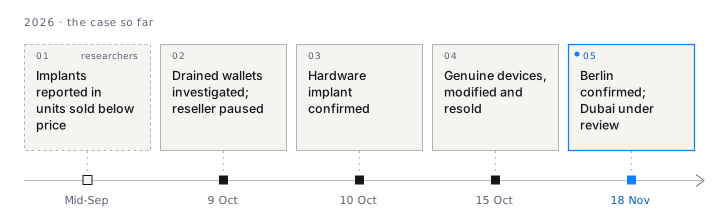
According to Ledger's own statements, an organised criminal group bought genuine Ledger devices, opened them, fitted hidden components and returned them to distribution through resellers. The cases Ledger confirmed first were linked to CryptoBilis, an authorised reseller in Malaysia; on 9 October Ledger asked it to stop selling and shipping Ledger devices, and on 10 October confirmed a hardware implant in at least one unit. Independent researchers also found affected units bought through online marketplaces in Japan, and reported that tampered devices were sold at close to half the usual price.
On 18 November Ledger confirmed tampered units in Berlin and said it was examining two suspected devices in Dubai. It asked anyone who bought a device in Berlin since January 2026 to contact support, and offered X-ray inspection of suspect units at its factory in France for a limited time.
Ledger has not published a loss figure and describes the number of affected devices as limited. A third-party on-chain analysis cited in press reports estimates about 335 wallets and roughly $102 million affected in Southeast Asia, and around $1.68 million across 16 wallets in Dubai and Berlin. Those numbers are estimates and may change as the investigation continues.
Why the usual checks didn't catch it
Hardware wallets have a well-known defence against fakes: the device proves that its secure element — the chip that holds the keys — is genuine. Ledger calls this Genuine Check. Ledger's own support documentation is explicit that this check cannot detect an extra component added elsewhere in the device while the original secure element is intact. That is precisely the situation here.
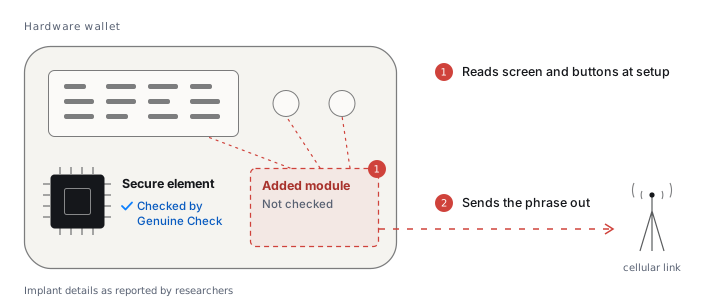
Researchers who opened affected units describe a small module hidden behind the screen or under the battery, with its own cellular connection. In their account it read what the screen displayed and which buttons were pressed during setup — the one moment the recovery phrase is shown in full — and sent it out. Ledger has confirmed an "unauthorized hardware implant" but has not confirmed these technical details, so treat them as the researchers' findings.
The chip did its job. The attack went around it — through the screen, the buttons and the path the device took to reach its owner.
Tamper-evident packaging did not stop it either. Packaging shows that a box was opened; it cannot prove that the box was not opened and resealed by someone with the time and tools to do it well.
The real lesson: every signing device has a chain of trust
Whatever you use to hold your keys offline, you are trusting a chain of things at once. The code has to be correct. The hardware has to be what it claims to be. The device has to reach you without being changed on the way. The seed has to be created privately. And the link between the offline device and the online world has to carry only what it should.
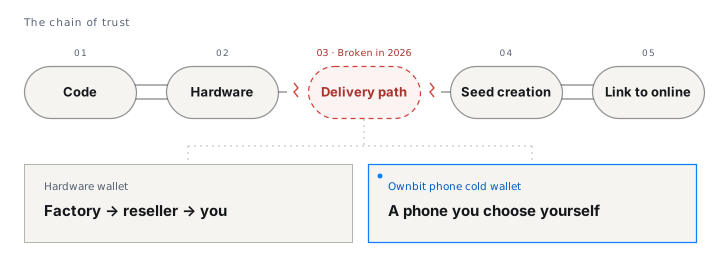
This case broke the third link: the path from factory to owner. It is worth noticing why that link is attractive to attackers. A hardware wallet has one purpose. Everyone who buys one is, by definition, someone who holds crypto worth protecting, and every unit from a given reseller passes through the same hands. An attacker who compromises a batch knows exactly what they will catch.
Where a phone cold wallet is different
Ownbit's cold wallet takes a different route: a spare phone, set up once and kept permanently offline, signs transactions; your everyday phone holds only public keys and talks to it by QR code. Here is what that changes in light of this case — stated as precisely as we can.
- There is no device to intercept on its way to you. Ownbit is an app. You put it on a phone you already own or buy through ordinary channels, so there is no "Ownbit device" moving through a reseller that an attacker could open in bulk. Nothing stops someone tampering with a phone, but they cannot know in advance which phone will become someone's cold wallet — the economics that made this attack worthwhile do not carry over.
- The only link to the online world is a QR code. The offline phone has no cable, Bluetooth or network connection to your everyday phone; what crosses the gap is what you can see on screen. Set up properly — factory reset, no SIM or eSIM profile, never joined to Wi‑Fi — it holds no credentials it could use to reach the internet.
- A full screen to check what you sign. The whole receiving address, amount and contract details are shown in full on a phone-sized screen before you sign, rather than scrolled across a small display.
- The code that touches your keys can be read. Since version 5.0, the iOS app's key-handling code — seed generation, key storage, derivation and signing — is open source under the MIT licence.
- Starting over costs nothing. If you ever doubt the phone, reset it or move to another one and restore from your seed (or better, create a new one and move the funds). There is no device to send back or replace.
None of this makes a phone immune. A phone that was compromised before you set it up, or one you later connect to a network, is a real risk. That is why the setup matters: use a phone from a source you trust, reset it, keep it offline for good, and treat it as a dedicated signer, not a phone.
Where hardware wallets remain stronger
It would be easy to turn this case into a verdict against hardware wallets. It is not one. A good hardware wallet bought directly from its maker remains an excellent way to hold keys, and in some respects it is stronger than a phone:
- Physical extraction. A secure element is designed to resist attacks on the chip itself. If someone steals the device, getting the key out is far harder than on a phone protected only by its own encryption and an app password.
- A minimal device. A dedicated signer runs far less software than a smartphone, which means less code that could go wrong.
- Breadth and track record. The major hardware wallets support thousands of assets and have years of public scrutiny behind them.
Our own comparison of Ownbit with Ledger and OneKey, point by point, marks these advantages too: phone cold wallet vs hardware wallet.
The structural answer: don't let one device be everything
Notice what every victim had in common. Each wallet depended on a single device and a single seed, so whoever captured that one seed captured everything. The decisive defence is not choosing a better single device — it is not relying on any single device at all.
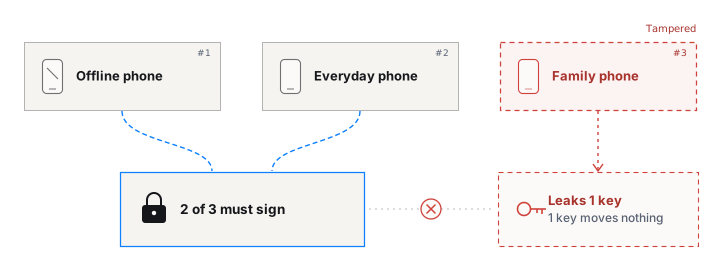
In a 2-of-3 MultiSig, three keys live on three independent devices and any two must sign. A tampered device leaks one key; one key cannot move anything. Mixing device types and sources — an offline phone, your everyday phone, a family member's phone, or a hardware wallet bought directly from its maker in a separate setup — makes it even less likely that the same problem affects two keys at once. Ownbit builds MultiSig in, with offline signing, on Bitcoin, Ethereum and other EVM chains, TRON, Solana and more.
What to do now
- If you bought a Ledger device from a reseller or marketplace, follow Ledger's guidance: stop using a suspected device, do not open it yourself, and move funds to a new wallet created on a device bought directly from ledger.com, with a new recovery phrase. Do not reuse the old phrase or passphrase.
- Buy signing devices directly from the maker, whatever the brand, and be wary of discounts that seem too good.
- Treat setup as the most sensitive moment. Create the seed yourself, privately, on a device you trust, and never type a recovery phrase into a website or an online device.
- If you use a phone as a cold wallet, use one from a source you trust, factory-reset it, remove the SIM and any eSIM profile, never connect it to a network, and keep the seed backed up offline.
- Put larger holdings behind a MultiSig threshold spread across independent devices, so that no single compromised device — of any kind — can move your funds.
Frequently asked questions
Was Ledger's secure chip hacked?
No. Ledger states there is no flaw in its secure element or operating system. The attack added a separate component to genuine devices before they reached their owners, and captured the recovery phrase around the chip rather than through it.
I bought my Ledger from ledger.com. Am I affected?
Ledger says no confirmed case involves a device bought on ledger.com. If you bought from a reseller or marketplace, especially in Southeast Asia, Berlin or Dubai, follow Ledger's guidance and contact its support.
Could the same thing happen to a phone?
A phone can be tampered with too, and a phone you later connect to a network can be compromised in software. What differs is targeting: there is no batch of "Ownbit devices" moving through a reseller, so an attacker cannot know which phone will become a cold wallet. Use a phone from a source you trust, reset it, and keep it offline for good.
Is a phone cold wallet safer than a hardware wallet?
Neither is safer in every way. A hardware wallet's secure element is stronger against physical extraction. A phone cold wallet avoids the purchased-device supply chain, talks only by QR code and shows everything on a large screen. For larger holdings the strongest answer is MultiSig, so that no single device of either kind holds everything.
How does MultiSig help in a case like this?
In a 2-of-3 MultiSig, a compromised device exposes one key, and one key cannot move funds. Keeping the keys on independent devices from different sources makes it unlikely that one problem reaches two keys.
Sources
- Ledger — response to the hardware implant attack (15 Oct 2026)
- Ledger — update on the hardware implant investigation (18 Nov 2026)
- Ledger support — what Genuine Check verifies
- BleepingComputer — Ledger confirms hardware wallet spy implant (12 Oct 2026)
- Bitcoin Magazine — tampered wallets in Berlin and Dubai (19 Nov 2026)
If this case has you rethinking your setup, Ownbit turns a spare phone into an offline signer that talks only by QR code, and builds MultiSig in so that no single device holds everything. Compare it with hardware wallets point by point in phone cold wallet vs hardware wallet, or see how the Ownbit cold wallet works. Every new user gets a 7-day free trial.