




Never share a seedHeirs hold their own keys in advance, so you never expose your seed phrase while you are alive.
Bitcoin inheritance planning
Bitcoin inheritance, without handing over your keys
Pass on your bitcoin — and the rest of your crypto — to the people you love, without ever sharing your seed phrase and without trusting a company or lawyer to hold your keys.
- Heirs can't spend alone
- Every spend you sign resets the 416-day clock
- No court, no paperwork
Bitcoin, plus ETH, TRON, Solana and EVM chains
Try itThe 416-day handover
You2 keysIn control
/ 416
Your heir1 keyCan't move funds alone
Any spend you sign, or a tap of Keep Active, resets the clock to zero.
416-day handoverIf you become permanently inactive, the remaining family members can recover the assets after the waiting period.
No third-party custodyNo company, lawyer, or exchange holds your keys. Inheritance stays fully self-custodial and on-chain.
The problem nobody plans for
What happens to your bitcoin when you die?
Most bitcoin is protected by a single seed phrase held by a single person. That is exactly what makes it disappear the day something goes wrong.
One seed, one point of failure
If the only person who knows the seed phrase dies or loses it, the funds are gone. No support line and no password reset can bring self-custody assets back.
Handing over the seed is dangerous
Writing your seed in a will or giving it to family early means anyone who reads it can drain everything today — long before it is ever needed.
Custodians and services fail
Third-party inheritance services can shut down, freeze accounts, or demand fees and paperwork. Your family shouldn't depend on a company holding their keys.
How Ownbit solves it
How bitcoin inheritance works in Ownbit
Our Inheritance MultiSig vault turns bitcoin inheritance planning into a defined, on-chain plan instead of a hope. Your heirs hold real keys from day one; in an accident-protection plan where you hold the controlling keys, they can only inherit — never spend behind your back.
1
Set up the vault
Create a shared MultiSig — for example 2-of-3 — where you and your chosen heirs each control a separate signer key on their own device.
2
Live normally
While you are active, spending follows the signature rule you set. No single heir can move funds alone, and you never reveal your seed phrase.
3
Seamless handover
If you become permanently inactive, the 416-day recovery path lets your heirs regain control of the assets — cleanly, on-chain, and without a court.
Choose your inheritance setup
Three ways to plan your bitcoin inheritance
In a MultiSig, every seed phrase is a separate key, and each key represents one participant. Every option below is fully self-custodial — Ownbit never receives your seed phrase and can never spend alone — but how recovery works depends on the vault type and the network:
| Setup | Who can recover | What it depends on |
|---|---|---|
| Standard threshold MultiSig (e.g. 2-of-3) | Any participants who together meet the normal threshold, at any time | No third party: recoverable without Ownbit whenever enough keys remain |
| Accident protection on EVM chains | The remaining participants, after 416 days of inactivity | The open-source accident-protection contract, which enforces the rule on-chain |
| Accident protection on BTC, TRON and Solana | The remaining participants plus one assisting signature from Ownbit Official, after 416 days of inactivity and a request through official support | Ownbit Official's co-signature, which is discretionary under our Terms §7 and can be delayed, refused or discontinued. Ownbit cannot spend alone. |
You hold two keys, one goes to your heir
You hold two keys (two seed phrases) and give one of them to your heir (a spouse or child) — so there are two participants, you and the heir. Day to day you sign with both keys. If you pass away and 416 days of inactivity pass, your heir's single key can spend the funds — on EVM chains the open-source accident-protection contract enforces this; on BTC, TRON and Solana, Ownbit joins as an assisting co-signer, making it effectively 2-of-3.
Best when one person controls the assets and wants a planned handover to one heir.You, your spouse and your child each hold a key
Three participants, each holding one key (one seed phrase). Everyday spending needs any two of the three keys — normally you and your spouse. If one of you is gone, the remaining two (spouse + child, or you + child) can still sign, so inheritance works with no waiting period and no third party involved at all. Note that any two key holders can spend at any time — including your spouse and child together while you are still active — so this plan shares control rather than giving you a veto.
Best for families who want shared control today and resilience if one member is lost.Four keys — you decide how to spread them
There are four keys (four seed phrases) in total, across four participants: you can hold three yourself, or just one or two, and choose who keeps the rest. Everyday spending needs any three keys. If something happens to you, your heirs only need two keys between them to recover — EVM chains use the accident-protection contract, while BTC, TRON and Solana become an effective 3-of-5 with Ownbit's assisting signature. Hold three keys yourself if nothing should move without you while you are active; with fewer, the other key holders can reach the threshold together.
Best for larger families or high-value, multi-generation holdings.
Multi-chain
Bitcoin first, every major chain covered
Plan for your bitcoin first — and the same plan covers ETH, BSC, TRX, SOL, BASE, ARB, MATIC, BCH, LTC, DOGE — so one family signing model protects the whole portfolio.
BTCETHBSCTRXSOLBASEOPARBMATICBCHLTCDOGE
Do it right
Best practices for a durable legacy plan
For the step-by-step version — what to set up, what to write down, and how to brief your heirs — read our full bitcoin inheritance planning guide.
Use cold signer keys
Create the most important signer wallets as cold wallets so the keys that protect a lifetime of savings stay offline.
Write down the plan, not the seed
Leave your heirs clear instructions on how the vault is structured and how recovery works — but never the seed phrases themselves.
Test the recovery once
Do a small dry-run so every heir knows how to open Ownbit, find their key, and complete a recovery before it truly matters.
FAQ
Bitcoin inheritance questions, answered
How do I pass on my bitcoin when I die?
If your bitcoin sits in a single wallet secured by one seed phrase, and no one else can access that seed phrase, the coins are effectively lost forever when you die or lose access. There is no bank, no password reset, and no support line that can recover self-custody funds. A bitcoin inheritance plan built on MultiSig solves this: your heirs hold their own keys in advance, so they can recover the assets without you ever exposing your seed phrase while you are alive.
What is the best way to leave bitcoin to my family?
Not by writing your seed phrase into a will — anyone who reads it can spend the funds immediately. The safer way is a shared vault in which you and your heirs each control a separate signer key. Day-to-day, spending follows the signature rule you chose (for example 2-of-3); your heirs never see your seed phrase. Whether they can spend without you while you are active depends on the setup: if you hold the controlling keys (two keys in a 2-of-2, or three in a 3-of-4), they cannot; in a standard 2-of-3, any two key holders — for example your spouse and child — can spend at any time. If you become permanently inactive, the built-in 416-day handover lets the remaining qualified signers regain control.
Do I need a lawyer for bitcoin inheritance?
No. Ownbit's Inheritance MultiSig is a technical plan you set up yourself inside the app, at no extra cost and without handing keys to any third party. Many families still document the plan alongside a traditional will. Recovery needs no court: a standard threshold MultiSig can be recovered without Ownbit whenever enough keys remain, and on EVM chains the accident-protection path is enforced by an open-source contract; on BTC, TRON and Solana that path needs an assisting signature from Ownbit Official, which is discretionary under our Terms.
Is this self-custody, or does a company hold my keys?
It is fully self-custody. Ownbit never holds your seed phrases or your private keys, and there is no custodian or lawyer holding the assets. Every signer key stays with the family member who owns it. On EVM chains an open-source contract enforces the inheritance rule with no third party at all; on BTC, TRON, Solana and similar chains Ownbit Official joins only as an assisting co-signer that may add one signature, on a participant's request, after the 416-day inactivity condition — at its discretion under our Terms §7. Either way, Ownbit can never move funds on its own.
How does the inheritance actually work on-chain?
Ownbit uses two mechanisms depending on the chain. On EVM chains (Ethereum, BSC, Base, Arbitrum, Optimism, Polygon) inheritance is a smart-contract feature: your wallet is an on-chain "accident-protection" MultiSig contract and the rule lives in the code. For example, in a 2-of-2 accident-protection wallet, if one party stays inactive for more than 416 days, the other party can spend the assets directly — no third party involved. The contracts are fully open source: github.com/bitbill/ownbit-multisig-contracts. On BTC, TRON, Solana and similar chains that cannot run this logic natively, inheritance works through an assisting watch-only participant (wallet ID: ownbit). For example, a 3-of-4 inheritance BTC vault is actually created as a 3-of-5 wallet; if one party is inactive for more than 416 days and a participant asks through Ownbit's official support channels, Ownbit Official can add its signature as that extra participant so your heirs can complete the inheritance spend. That co-signing is discretionary: under our Terms §7 it can be delayed, refused or discontinued. Either way, Ownbit holds at most one assisting key, never receives your seed phrase and can never move funds alone.
How does the 416-day handover work?
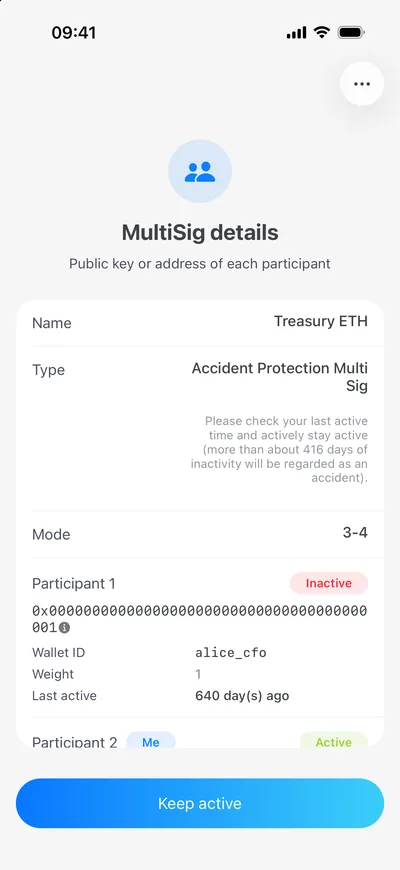
The 416-day timer is an accident- and inheritance-protection mechanism. If one participant stops signing — because they passed away, lost their device, or lost their seed phrase — the wallet enters a recovery scenario. After 416 days of inactivity, the remaining qualified signer or designated heir can regain the ability to move the assets, according to the plan you configured.
How do I make sure I stay active and never trigger the 416-day timer?
Staying active is effortless. Every time you take part in a successful spend — signing a transaction that actually goes through — your participant status is automatically refreshed to the current date, resetting the 416-day timer. If you expect a long stretch without spending, just open that wallet in Ownbit and tap the "Keep Active" button once; a single tap instantly updates you to active again. In practice, tapping it once every six months to a year is more than enough to make sure the 416-day condition is never reached while you are around.
Is this only for Bitcoin?
No. Bitcoin comes first for most families, and the same plan covers ETH, BSC, TRX, SOL, BASE, ARB, MATIC, BCH, LTC, DOGE — so one crypto inheritance strategy secures a multi-chain portfolio.
In the app
A vault your family can still open.
Give keys to the people you trust. With every key backed up, one lost phone doesn't mean lost coins.
Download Ownbit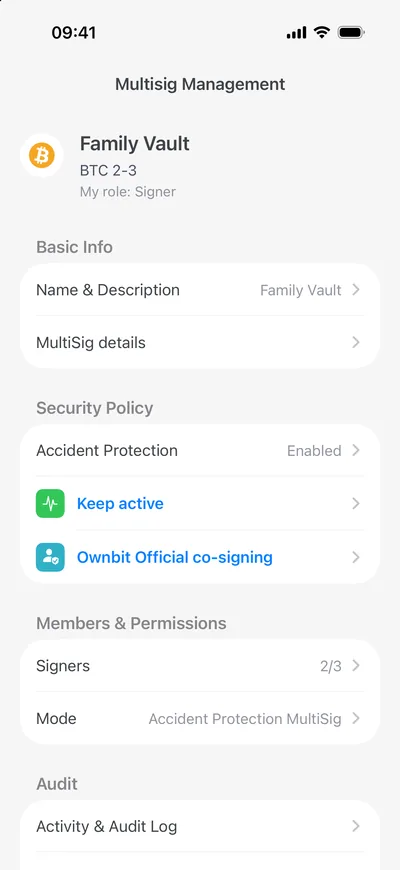
Download
Set up the handover while you still can
Start your bitcoin inheritance planning today: build the vault, name your heirs, and give your family a clear, self-custodial path to your bitcoin — no seed phrase ever leaves your hands.