

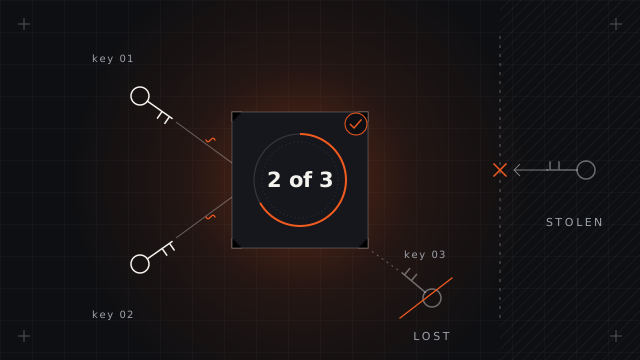
Every self-custody plan is secretly a bet on which disaster arrives first. Keep a single seed phrase with no copies, and you are betting that loss never comes for it. Scatter copies of that phrase for safety, and you are betting that none of them is ever found. A 2 of 3 multisig refuses to pick a side: three independent keys control the wallet, any two of them can move funds, and no single key can. One key can be lost, and your coins survive. One key can be stolen, and your coins survive that too.
That double tolerance is the whole argument, and it deserves precision, because no single-key arrangement — hardware wallet, steel plate, bank vault — delivers it. Below: why protection against loss and protection against theft pull in opposite directions, what the 2-of-3 threshold actually guarantees and where it stops, how to place the three keys so they cannot share a fate, and the one drill that keeps the scheme healthy for decades.
Loss and theft pull in opposite directions
Coins die in two ways. They are taken — phishing, malware, a burglary, a failed custodian — or they are stranded, because the only key that could move them no longer exists anywhere. The second failure mode is not the rare one: Chainalysis has estimated that around 20% of all bitcoin sits in wallets whose keys appear lost for good. Nobody attacked those coins. Somebody lost a piece of paper, a phone, or a memory.
With a single seed phrase, every defense against one failure feeds the other. Make extra copies and distribute them, and loss becomes unlikely — but each copy is a complete spending credential, so theft now has several targets instead of one. Keep exactly one copy and hide it deeply, and theft gets harder — but one flood, one fire, or one forgotten hiding place ends everything. We walked through this trap in Your seed phrase is a single point of failure; the short version is that with one key there is no setting on the dial that protects both ends at once.
Security against theft wants fewer copies of a key. Security against loss wants more. A signing threshold is how you stop choosing.
What a 2 of 3 multisig actually guarantees
A 2 of 3 multisig is a wallet controlled by three independent keys, any two of which must sign before funds can move. The rule is enforced by the chain itself, not by an app or a company: Bitcoin has understood multisig at the script level since its early years, and pay-to-script-hash made it practical to use in 2012 — and taproot has been making such spends more compact and private since 2021 — while on Ethereum and similar networks the threshold lives in a contract anyone can read.
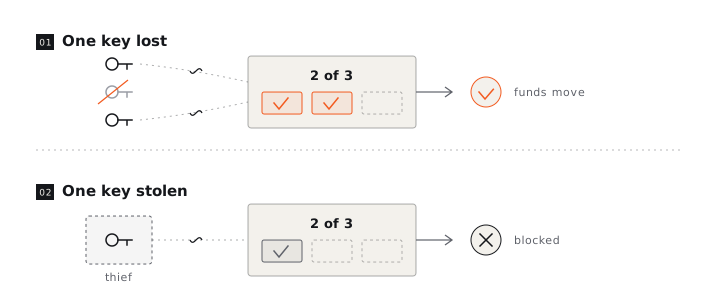
Run the two failure modes through that rule. Lose any one key — the phone dies, the paper burns — and the two remaining keys still meet the threshold: you sign a transaction that moves everything to a fresh wallet and carry on. Now run theft: an attacker who obtains any one key holds one signature where two are required, and can take nothing. To actually steal from a well-placed 2-of-3, an attacker must compromise two keys kept in different places, in different forms, before you notice the first breach — a categorically harder crime than photographing a seed phrase left in a drawer.
One honest boundary. If two keys fail at the same time — one lost and, before you have rotated, another stolen outright — a 2-of-3 does not hand the funds to the thief, but it can leave them frozen: you hold one signature, the attacker holds one, and nobody reaches two. Frozen is a far better worst case than stolen, and the rotation drill later in this article exists precisely to keep that scenario theoretical.
Why not 2-of-2, 3-of-5, or one very good hardware wallet?
Every alternative gives up one of the two tolerances.
- 1-of-1 — a single key, however well kept. A hardware wallet protects that key admirably while it sits in the device, but the paper backup behind the device can spend alone, so the arithmetic never changes: one credential, total power, single point of failure.
- 2-of-2. Full theft tolerance — no key can act alone — and zero loss tolerance: lose either key and the funds are stuck permanently. Two-party accounts use 2-of-2 for good reasons, but it needs additional accident-protection machinery before it is safe as anyone’s primary vault.
- 3-of-5 and larger. More redundancy, and the right shape for organizations with several officers and a written procedure. For one person, five seed phrases mean five backups to create, verify, separate geographically, and re-check for years. The operational surface, not the cryptography, is where mistakes breed.
2-of-3 is the smallest threshold that survives both a lost key and a stolen key, which is why it is the standard recommendation for personal custody rather than a compromise between better options. MPC wallets reach a similar risk shape by splitting one key mathematically instead of coordinating three whole keys; there are genuine trade-offs on both sides, and we compared them in MPC vs MultiSig: an honest comparison. The multisig property that matters most here: each of the three keys is an ordinary, independently recoverable wallet key, not a fragment of a proprietary protocol.
Place the three keys so they cannot share a fate
Threshold arithmetic only pays off if the keys genuinely fail independently. The placement pattern we recommend requires no hardware purchase at all:
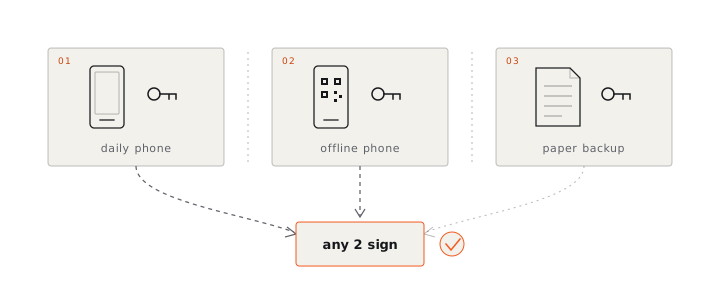
- Key 1 — your daily phone. The signer you carry. It initiates transactions and contributes the first signature, and on its own it can spend nothing — which quietly changes what a phone thief or a malware infection is worth.
- Key 2 — a spare phone, permanently offline. Most households already own one. Wiped and kept off the network for good, it becomes an air-gapped cold signer: the unsigned transaction goes in as a QR code, the signature comes out as a QR code, and key material never touches an online machine.
- Key 3 — paper, somewhere else entirely. A seed phrase written once and stored in another building — a bank box, or a trusted relative’s safe in another city. It exists for recovery days, not routine, and is never typed into anything connected to the internet.
Two rules govern the layout. No two keys may ever share a building, so no single burglary, fire, or flood can reach a quorum. And geographic separation is a security control, not a storage preference — distance is what turns “compromise two keys” from an evening’s work into a coordinated campaign. In an Ownbit multisig every key is a standard BIP39 seed phrase, so any of the three positions can also be filled from hardware you already own: a Ledger or Trezor mnemonic imports as one signer among three. Ownbit’s MultiSig coordinates the co-signing across chains, so the same three keys can govern BTC, ETH and its major L2s, TRON, Solana and more — and a Bitcoin multisig wallet built this way settles the 2-of-3 directly in Bitcoin script, with published self-recovery guides for moving funds even without Ownbit’s servers.
The first-failure drill
A 2-of-3 stays healthy through one habit: treat any single key event as a fire alarm, not an inconvenience.
- A key is lost — the daily phone dies, the paper cannot be found. The two remaining keys still spend, so use them to move everything to a brand-new 2-of-3 with a full set of three keys, then retire the old wallet. Within days, not months.
- A key may be exposed — a break-in, a suspicious device, a backup envelope that looks opened. Same drill, same urgency. The moment funds land at the new address, whatever the attacker holds is one signature toward a threshold that no longer guards anything.
- Nothing has failed yet. Run one full co-signed test spend with a small amount when you first set up, so every key has signed once and the ceremony is familiar. An emergency is the wrong moment to learn the workflow.
The drill is what turns “two simultaneous failures” from a real risk into an engineered near-impossibility: the window in which a second failure can hurt lasts exactly as long as you take to rotate after the first.
Where 2-of-3 is not the answer
Fitting the tool to the amount is part of the argument. For a balance you could lose with a shrug, the ceremony costs more than the risk covers, and a single well-kept seed phrase is a defensible choice. A regulated custodian is likewise legitimate for someone who will never maintain keys — provided the collapse of FTX in 2022 is priced in as a reminder that a custodian is a counterparty, not a backup. Organizations holding treasury funds usually need more than a bare threshold — roles, limits, whitelists — which is its own topic. And any scheme that quietly reintroduces a single trusted party deserves scrutiny wherever it appears: the backlash to Ledger Recover in 2023 was, at bottom, users rejecting seed material leaving the device on someone else’s terms. A 2 of 3 multisig you place yourself has no such party. Three ordinary keys, two ordinary signatures, and arithmetic anyone can verify.
Frequently asked questions
What is a 2 of 3 multisig wallet?
A 2 of 3 multisig is a wallet controlled by three independent keys, any two of which must sign a transaction before funds can move. No single key can spend, so the theft of one key takes nothing; any two keys can recover the funds, so the loss of one key strands nothing. The threshold is enforced by the blockchain itself — by script on Bitcoin and by an inspectable contract on networks like Ethereum.
What happens if I lose one key of a 2-of-3 multisig?
Nothing is lost. The two remaining keys still meet the threshold, so you use them to sign a transaction moving all funds to a freshly created multisig with a full set of three keys. Do it promptly: the time between losing one key and rotating the wallet is the only window in which a second failure could hurt you.
Can a thief who steals one of my three keys take anything?
No. One key produces one signature and the wallet requires two, so a thief holding any single key — or a photograph of any single seed phrase — can move nothing. Treat the event seriously anyway: rotate to a fresh 2-of-3 with your remaining keys so the stolen key becomes permanently worthless.
Do I need three hardware wallets for a 2 of 3 multisig?
No. A daily phone, a spare phone kept permanently offline as a QR-based cold signer, and a paper seed phrase stored in another location form a complete 2-of-3 with no extra hardware. In Ownbit each key is a standard BIP39 seed phrase, and an existing Ledger or Trezor mnemonic can be imported as one of the three keys if you prefer.
If the model reads well on paper, test it with pocket change before trusting it with conviction. Ownbit’s MultiSig sets up a 2-of-3 across two phones and a paper backup in an afternoon, with no hardware to buy, and the same keys can run a Bitcoin multisig wallet whose threshold is enforced by Bitcoin script itself. Every new user gets a 7-day free trial, and your keys and assets remain yours regardless of membership.