

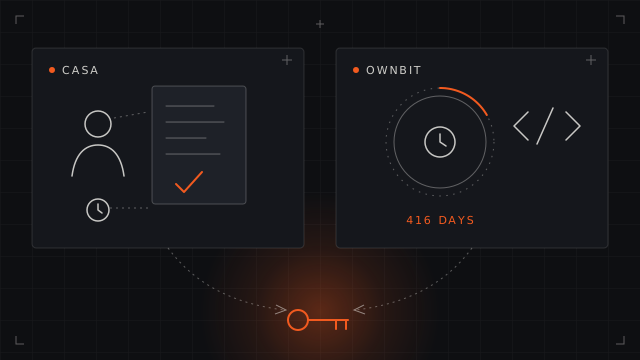
Casa and Ownbit disagree on plenty, but they agree completely on the sentence that matters most: your heirs should never receive your seed phrase. Both build inheritance on threshold multisig, where an heir holds a key of their own from day one and nobody — not the heir, not the company — can move funds alone. So if you are researching Casa crypto inheritance and weighing it against Ownbit's Inheritance MultiSig, the seed-phrase question is already settled. What you are actually choosing between is two answers to a harder question: who, or what, gets to decide that you are gone?
Casa's answer is people. A member names a beneficiary in advance; after the member's death, the beneficiary files a claim, Casa verifies it through a human process with a built-in waiting period, and then co-signs the transfer alongside the beneficiary's own key. Ownbit's answer is code. Every inheritance vault carries a 416-day inactivity timer, enforced by an open-source smart contract on EVM chains and by a strictly limited assisting co-signature on Bitcoin, TRON, and Solana. Neither model is simply better. They are different trust models with different failure modes; this comparison lays both out so you can decide which failure mode you would rather carry.
The ground Casa and Ownbit share
Start with the agreement, because it rules out the plans that actually lose money. A seed phrase is not a password protecting your crypto; it is the crypto — anyone who reads it can spend everything, immediately and irreversibly. That is why inheritance schemes built on sealed envelopes, wills, and safe-deposit boxes fail: they convert a problem decades away into a live risk that starts today. We made the full argument in Your seed phrase is a single point of failure, and both companies design as if they had read it.
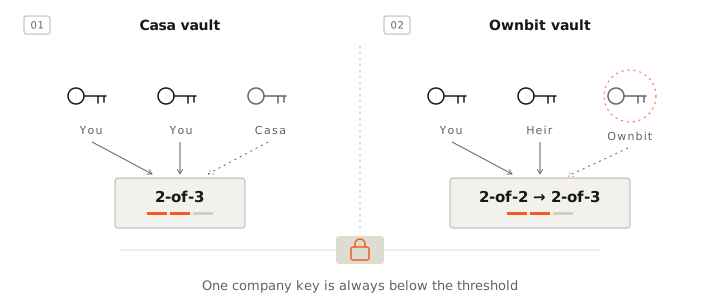
Both replace seed sharing with the same primitive. A threshold multisig requires M of N independent keys to move funds, so no single participant can spend alone. Casa's vaults come as 2-of-3 or 3-of-5, with Casa holding exactly one recovery key — never enough to reach the threshold by itself. Ownbit's accident-protection vaults hold the same line: on chains where Ownbit joins as an assisting co-signer, a 2-of-2 becomes effectively a 2-of-3 and a 3-of-4 effectively a 3-of-5, and Ownbit's single signature can never satisfy the threshold on its own. In both designs the company is structurally locked out of your funds, which is the first bar any inheritance product must clear. For the deeper case behind keys-not-copies planning, see How to pass on your crypto without sharing a seed phrase.
How Casa crypto inheritance works
Casa is a US-based self-custody service best known for bitcoin-first multisig vaults, sold as paid annual subscription tiers. In a typical 2-of-3 setup you hold two keys — commonly one on your phone and one on a hardware wallet — while Casa holds the third as a recovery key it cannot use alone. Onboarding is deliberately concierge-grade: guided setup, hardware-wallet integration for people who already own Ledger or Trezor devices, and human support when something goes wrong. Casa has run this model for years, which counts for something in an industry where products vanish quickly, and coverage that began with Bitcoin has grown to include Ethereum and, over time, other assets such as stablecoins.
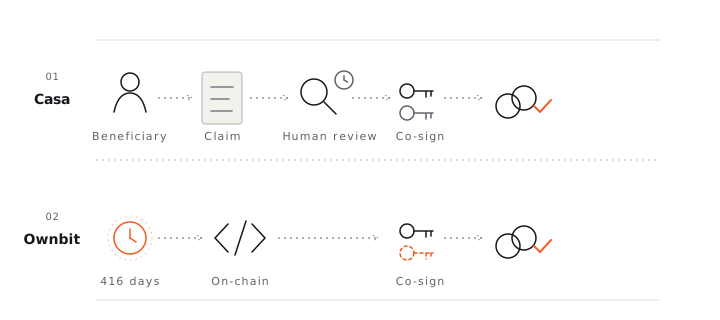
Casa Inheritance, announced in February 2024, extends that service to death. The member designates a beneficiary in advance and can prepare them while still alive. After the member dies, the beneficiary files a claim; Casa runs a human verification process that includes a waiting period, and once satisfied, co-signs the transfer together with the beneficiary's own key. No seed phrase changes hands at any point — the beneficiary's key plus Casa's signature completes the quorum.
Judge the model by what it buys you. A grieving, possibly non-technical heir gets patient humans on the other end of the process instead of a stack of instructions, and the waiting period gives contested or fraudulent claims time to surface. The trade is equally plain: the handover runs through Casa. The claim is filed with Casa, judged by Casa's process, and completed by Casa's co-signature, under a subscription that needs to stay in good standing. None of this is hidden — it is the product — but it means the moment of inheritance depends on a company existing, operating, and agreeing that the claim is valid.
How Ownbit handles the same problem
Ownbit's Bitcoin Inheritance replaces the claim process with a timer. Every vault carries a 416-day inactivity rule: if you go 416 days — a little under fourteen months — without taking part in a successful spend, the recovery path opens and the remaining participants can regain control without your key. While you are alive and active, nothing moves without your signature; any spend you co-sign resets the timer automatically, and if you expect a long quiet stretch, tapping Keep Active in the app resets it in one tap.
Enforcement depends on the chain. On Ethereum and other EVM networks the vault is an accident-protection smart contract, and the 416-day rule lives in open-source code you can read before depositing anything. On Bitcoin, TRON, and Solana — chains that cannot run that logic natively — Ownbit joins as the assisting co-signer described above, adding its signature only after the inactivity condition is met and never able to move funds alone. Coverage is multi-chain by default, including USDT on TRON, and the whole setup runs on ordinary phones — no hardware device required, each participant's key a standard BIP39 seed phrase generated on their own device.
The same honesty test applies here. What the timer buys you is minimized trust: on EVM chains the handover keeps working even if Ownbit disappears, and on every chain the company's signature sits below the threshold, so heirs never wait on a company's permission — and no company can act against them. The trade is bluntness. A timer counts; it does not judge. Heirs may wait up to fourteen months rather than a human-reviewed interval, and the discipline of staying active is yours — a twice-a-year reminder is plenty, but you have to set it. Families who want that discipline built into daily habit often start with Family MultiSig, where routine co-signing keeps every key warm long before the inheritance question arrives.
The real fork: human judgment vs an on-chain clock
Everything above reduces to one architectural choice. Casa put a human institution at the trigger; Ownbit put a clock there. Each choice absorbs a different kind of mess.
Human judgment absorbs the mess of reality. Death certificates arrive late, families dispute, a beneficiary may be unreachable or targeted by a scammer filing a false claim. A person can weigh all of that, and Casa's review-and-wait process exists precisely to weigh it. What human judgment cannot absorb is institutional failure: the process works only while the institution does, and you cannot independently verify a promise about how a future claim will be judged.
An on-chain timer absorbs institutional failure. The contract does not care whether the company behind it still exists, and you can read exactly what happens on day 417 before you deposit a single token. What the timer cannot absorb is nuance: it opens the recovery path after 416 quiet days whether the silence means death, incapacity, or forgetfulness — which is also why a single spend, or one tap of Keep Active, closes it again.
A human process can weigh evidence; a timer can only count. Choosing between Casa and Ownbit is choosing which of those limits you would rather plan around.
Practical differences beyond the trust model
- Assets. Casa is bitcoin-first, with Ethereum and selected other assets added over time. Ownbit is multi-chain by design — BTC, ETH and its L2s, TRON including USDT, Solana, BSC, and more — under one vault architecture.
- Hardware. Casa integrates hardware wallets and suits people who already own them. Ownbit is mobile-only: no hardware purchase is required, and a spare phone can serve as an air-gapped signer.
- Cost model. Casa sells paid annual subscription tiers that include its recovery key and inheritance service. Ownbit is a membership with a 7-day free trial for every new user, and keys and assets remain the user's regardless of membership status.
- Heir experience. Casa offers human, concierge support for beneficiaries — a genuine strength for non-technical heirs. Ownbit heirs hold their own keys and app from day one, which favors families willing to practice one co-signed transaction while everyone is alive.
- Verifiability. Ownbit's inheritance contracts are open source, and because every key is a standard BIP39 phrase, recovery works even without Ownbit's servers. Casa's process is documented and reputable, but it is a service commitment rather than an inspectable mechanism.
Which model fits you
Choose Casa if your holdings are bitcoin-heavy, you already use hardware wallets, and the person inheriting from you would rather deal with patient professionals than with an app — you are paying, deliberately, for people. Choose Ownbit if your holdings span chains — especially stablecoins like USDT on TRON — if you want the handover mechanism to be something you can read rather than something you are promised, and if you would rather the plan survive every company involved in creating it.
And keep perspective. Measured against the plans most people actually have — a seed phrase in a drawer, or nothing — either product is a categorical upgrade. As of this writing, a multisig with a below-threshold company key is the strongest inheritance pattern available for self-custodied crypto; human-versus-timer is a refinement inside that pattern, not a gulf.
Frequently asked questions
Does Casa crypto inheritance require sharing my seed phrase?
No. Casa's vaults are multisig: the beneficiary is designated in advance and, after a verified claim, co-signs the transfer with a key of their own while Casa adds its recovery-key signature. Ownbit works the same way on this point — in both products, heirs never see or receive your seed phrase.
What happens if Casa or Ownbit shuts down before my heirs need the wallet?
Casa members hold enough keys to meet the threshold, so a living member can always migrate funds — but the claim-and-verify flow assumes Casa is there to run it. Ownbit's EVM inheritance contracts keep working on-chain regardless, and on other chains every key is a standard BIP39 phrase, with published self-recovery guides for moving funds without Ownbit's servers.
Can Casa or Ownbit move my funds without my consent?
No. Casa holds one recovery key in a 2-of-3 or 3-of-5 vault; Ownbit's assisting co-signature is likewise a single key in an effectively 2-of-3 or 3-of-5 arrangement. In both designs one company signature can never meet the threshold, so neither company can move funds alone.
How long do heirs wait for funds with Casa vs Ownbit?
Casa runs a human verification process with a built-in waiting period after the beneficiary files a claim, so the interval depends on the review. Ownbit's recovery path opens only after 416 days of the owner's inactivity — roughly fourteen months — after which the remaining participants complete the handover directly, with no claim to file.
If the timer model matches how you think about trust, Ownbit's Inheritance MultiSig takes a few minutes to set up on iOS or Android — no hardware, a 7-day free trial for every new user, and your keys and assets remain yours whatever you decide about membership. If your family would benefit from practicing shared custody first, Family MultiSig is the gentler on-ramp. And if Casa's human-verified model is the one that lets you sleep, that is a reasonable choice too — just make sure whichever product you pick never asks your heirs to hold your seed phrase.