

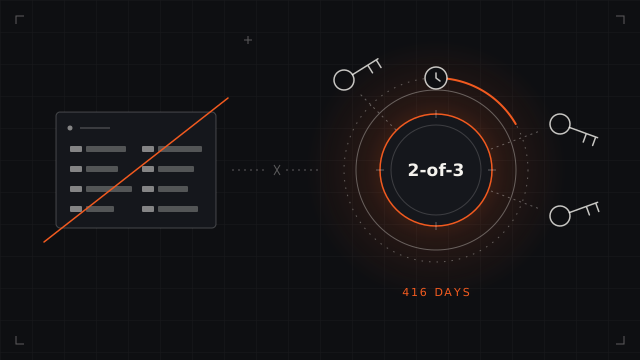
Most first attempts at crypto inheritance follow the same script: write the seed phrase on paper, seal it in an envelope, and hand it to a spouse, a lawyer, or a safe-deposit box. It feels responsible. In reality it converts a problem that arrives decades from now into a live risk that starts today — because a seed phrase is not a password protecting your crypto; it is the crypto. Anyone who reads the envelope can move everything, immediately, and the chain will treat that transaction as perfectly valid.
A crypto inheritance wallet worth the name inverts the model. Instead of duplicating your credentials and hoping the copies stay sealed, it gives your heirs their own keys from day one — keys that cannot spend while you are alive and active, and that gain recovery power only when a pre-agreed condition is met. Below: why seed sharing fails, what an inheritance wallet actually has to guarantee, and how Ownbit's Inheritance MultiSig enforces that guarantee on-chain with a 416-day handover.
Why handing over the seed phrase fails
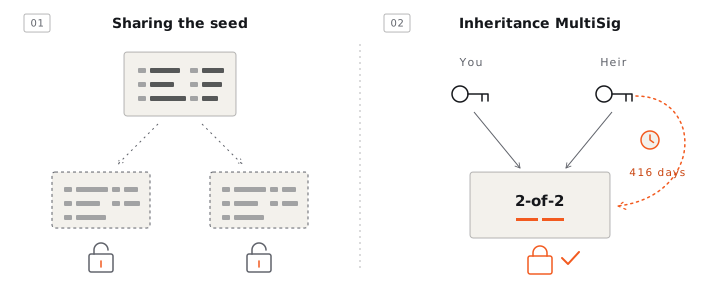
Start with the asymmetry. The inheritance event you are planning for is probably twenty or thirty years away; the risk you create by copying your seed phrase begins the moment the ink dries. Every copy is a complete, standalone spending credential. It never expires, it cannot be revoked short of moving every asset to a new wallet, and it grants exactly the same power to a burglar, a curious relative, or a compromised law office as it does to your intended heir.
The usual storage ideas do not fix this. Wills pass through probate, and in many jurisdictions a probated will becomes a public document. Safe-deposit boxes are subject to bank hours, access disputes, and court orders — and anyone who can open the box can spend the coins. We covered the underlying problem in Your seed phrase is a single point of failure; inheritance planning done by photocopying only multiplies the points of failure.
The opposite mistake is just as expensive. When the Canadian exchange QuadrigaCX collapsed in 2019, its founder was reported to have died holding sole access to wallets with roughly $145M of customer funds. Later investigation complicated that story considerably, but the lesson survived: access concentrated in one head disappears with that head. Chainalysis has estimated that around 20% of all bitcoin may already be lost or stranded in wallets whose keys are gone. Between the two failure modes — keys shared too widely and keys not shared at all — sits a fairly narrow target.
A useful test for any inheritance plan: does it create a new way to lose your coins while you are still alive? If yes, keep looking.
What a crypto inheritance wallet has to guarantee
A crypto inheritance wallet is a wallet in which heirs hold their own keys from day one but cannot spend until a pre-agreed condition is met. That definition implies four hard requirements:
- No new live risk. Setting up the plan must not place any copy of your credentials in anyone else's hands.
- No dependence on a company's survival. When Ledger announced its Recover service in 2023, the backlash was less about the cryptography than the principle: people do not want seed material leaving the device, or recovery hinging on a subscription staying online. An inheritance plan should outlive every business involved in creating it.
- Enforcement you can verify. A promise in a terms-of-service document is not a mechanism. The condition that transfers control should be enforced by code or protocol rules anyone can inspect.
- Coverage of what you actually hold. A plan that protects your ETH but not your BTC or USDT is half a plan.
Other approaches serve real needs, and it is worth being fair about them. A regulated custodian is a legitimate choice for estates that want institutional paperwork and accept counterparty risk. A hardware wallet secures a single key superbly but says nothing about succession — the moment you write down instructions for opening it, you are back to seed sharing. MPC wallets distribute signing mathematically; we compared the trade-offs honestly in MPC vs MultiSig. For inheritance specifically, multisig has one decisive property: each participant's key is a standard, independently recoverable wallet rather than a fragment of a proprietary scheme.
Heirs hold keys — not your keys
Ownbit's Bitcoin Inheritance builds the vault as an ordinary threshold multisig. In an Ownbit multisig, every key is a standard BIP39 seed phrase, and every seed phrase represents one participant. A common setup is 2-of-2 with accident protection: you hold one key, your heir holds the other, each generated on that person's own phone. While you are active, any spend needs both signatures — your heir cannot move a single satoshi alone, and you never reveal your phrase to anyone. Larger families use 3-of-4 the same way, spreading four keys across the household.
This is the same machinery families already use for joint custody. If day-to-day shared spending matters as much as succession, Family MultiSig is the natural starting point — the co-signing habits a family builds while everyone is healthy are exactly the habits an inheritance depends on later.
The obvious question: if spending always requires your signature, what happens when you are gone? That is what the 416-day mechanism answers.
The 416-day handover, enforced on-chain
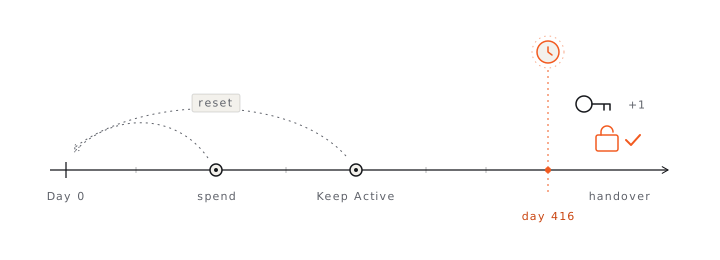
Every Ownbit inheritance vault carries an inactivity timer. If a participant goes 416 days — a little under fourteen months — without taking part in a successful spend, the wallet enters its recovery path and the remaining participants can regain control without that key. Two details keep this safe in practice: any successful spend automatically refreshes the active status of everyone who signed, and if you expect a long quiet stretch, opening the wallet and tapping Keep Active resets the timer in one tap. A calendar reminder twice a year is more than enough.
How the handover is enforced depends on the chain. On Ethereum and other EVM networks — BSC, Base, Arbitrum, Optimism, Polygon — the vault is an accident-protection smart contract and the rule lives in the code. The contracts are open source, so you can read exactly what happens on day 417 before you deposit a single token. On chains that cannot run that logic natively — Bitcoin, TRON, Solana — Ownbit joins the wallet as an assisting co-signer: a 2-of-2 is created on-chain as effectively a 2-of-3, a 3-of-4 as effectively a 3-of-5. Ownbit's single signature is only ever added after the 416-day condition is met, and one signature can never satisfy the threshold, so Ownbit cannot move funds alone under any circumstances.
The result is a transfer of control you can verify rather than a promise you have to trust. Heirs hold real keys the entire time, nothing about your credentials ever leaves your device, and because every component is standards-compatible, the funds remain recoverable even without Ownbit's servers — the self-recovery guides linked in the footer of this site exist precisely for that case.
What multisig inheritance does not solve
Three honest limits. First, your heirs must know the vault exists — a perfectly engineered crypto inheritance wallet that nobody knows about fails as completely as a lost seed. Write a plain-language letter naming the app, the chains, and the key holders, with no seed words anywhere in it, and store it with your will. Second, each heir now has a seed phrase of their own to protect. The threshold contains the damage — a stolen heir key cannot spend by itself — but a lost heir key should prompt you to rebuild the vault at a fresh address while you are still around to co-sign the move. Third, multisig governs access, not estate law. Inheritance tax, probate formalities, and provisions for minor heirs still belong with a professional in your jurisdiction.
A setup you can finish in a weekend
- Choose participants and a threshold. One heir: 2-of-2 with accident protection. Several: 3-of-4, so no single branch of the family controls the funds.
- Each person installs Ownbit and generates their own seed phrase on their own phone, backed up on paper and stored separately. Nobody reads anyone else's words — ever.
- Create the inheritance vault and verify the receiving address on every participant's device before funding it.
- Send a small test amount and run one full co-signed spend, so every signer has completed the ceremony once. The first signing should not happen at a funeral.
- Fund the vault and set a recurring reminder to tap Keep Active every six months.
- Write the letter, and file it with your will.
Frequently asked questions
Can my heirs move my crypto while I am still alive?
No. In an accident-protection setup such as 2-of-2 or 3-of-4, heirs alone cannot meet the signature threshold, and your seed phrase never leaves your device. The only path that works around your signature opens after 416 days of your inactivity — and any spend you sign, or a tap of Keep Active, resets that timer.
What is the best crypto inheritance wallet setup for a single heir?
A 2-of-2 MultiSig with accident protection is the simplest: you and your heir each hold one key, both signatures are needed to spend, and after 416 days of your inactivity your heir can complete the recovery. On EVM chains the rule is enforced by an open-source contract; on Bitcoin, TRON, and Solana, Ownbit's assisting co-signature completes the threshold only once the condition is met.
What happens if Ownbit shuts down before my heirs need the wallet?
Every key is a standard BIP39 seed phrase and the multisig itself is standards-compatible, so participants who can meet the threshold can always move funds without Ownbit's servers — published self-recovery guides walk through it. On EVM chains the inheritance contract lives on-chain and keeps working regardless. If Ownbit ever stopped operating, the prudent move would simply be to co-sign a migration to a new arrangement while all signers are available.
Is putting a seed phrase in my will really that risky?
Yes. A will tells a court who should receive your assets; a seed phrase written into that will hands whoever reads it the assets themselves. Probate can make the document accessible to executors, clerks, and in some jurisdictions the public — none of whom you intended to give spending power. Keep the will for legal intent and keep credentials out of it entirely.
If you want to see the model in practice, Ownbit's Inheritance MultiSig sets up an accident-protection vault in a few minutes on iOS or Android, and every new user gets a 7-day free trial — your keys and assets remain yours regardless of membership. If shared day-to-day custody matters as much as succession, start with Family MultiSig and add the inheritance timer when the family is ready.