

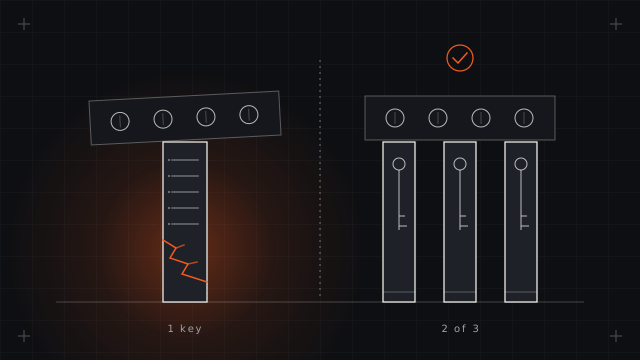
Twelve words. For most people reading this, that is the entire security model: twelve or twenty-four common English words, generated once, written on paper, controlling everything they own on-chain. The BIP39 seed phrase deserves real credit — it made wallet backup portable, standardized, and vendor-independent. But it also quietly became the industry's most concentrated risk. A seed phrase is a single point of failure: one secret that hands everything to whoever reads it, and buries everything if the only person who knows it loses it.
The takeaway up front: you cannot patch this with better hiding places. Every arrangement of a single seed phrase only trades exposure risk against loss risk. The fix is structural — spreading control across independent keys so that no single secret can drain the wallet or, by disappearing, lock it forever.
One secret, two opposite ways to fail
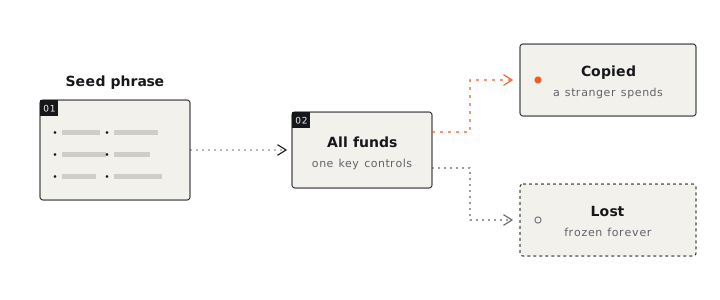
A seed phrase is the complete master key to a wallet: it deterministically derives every private key and every address, so whoever holds the words controls the funds, with no further questions asked. It is a bearer secret. There is no account to freeze, no password reset, and no support line with the authority to reverse a transfer.
A single point of failure is any component whose compromise or loss brings down the entire system. Judged by that definition, single-seed custody fails in both directions at once:
- Exposure. Anyone who reads the words — a burglar, a photo roll synced to the cloud, malware scanning a notes app, a relative who knows where you keep things — can sweep the wallet in minutes, from anywhere, irreversibly.
- Loss. If the only copy burns, floods, fades, or goes out with the trash, the coins remain visible on-chain forever and spendable never. The blockchain will happily show your balance to your grandchildren; none of them will be able to touch it.
The uncomfortable part is that these two risks pull against each other. Make more copies and you shrink the odds of loss while multiplying the odds of exposure. Keep one copy in an excellent hiding place and you have done the reverse. With a single seed phrase you can only choose which failure you are more likely to suffer — you cannot retire the failure mode itself.
The best-documented losses in the industry
None of this is hypothetical. In 2013, James Howells, an IT worker in Wales, threw out a hard drive holding the keys to roughly 7,500 BTC. It has been buried in a Newport landfill ever since, and a decade of excavation proposals has moved neither the local council nor the coins. Stefan Thomas, a San Francisco programmer, holds an encrypted IronKey drive containing the keys to just over 7,000 BTC — he lost the password years ago and, as widely reported in 2021, has used eight of the drive's ten guesses before it locks forever. Beyond the famous cases, widely cited Chainalysis estimates put permanently lost bitcoin at roughly 20% of all coins ever mined.
Note who these people are: an IT professional and an accomplished software engineer, both early enough into the industry to understand exactly what they held. Single-key custody does not punish ignorance — it punishes ordinary human fallibility, and it punishes it totally. A filing mistake that would cost a bank customer an afternoon of phone calls costs a self-custody holder everything, permanently.
Why more backups don't fix it
The standard advice after every loss story is the same: back it up properly. Stamp the words into steel so fire and water cannot destroy them. Keep copies in multiple locations. Rent a safe deposit box. All of this is sensible as far as it goes — and none of it touches the underlying structure, because every copy of a seed phrase is the whole key. A steel plate survives a house fire; it also survives long enough to be found. Each additional backup location is an additional place where a complete, spendable copy of your wealth sits waiting for the wrong reader.
The industry knows this, which is why "seed backup as a service" keeps being attempted. In May of this year, Ledger announced Recover, an opt-in subscription that shards an encrypted copy of the device seed among three custodians, tied to identity verification. The backlash from technical users was immediate and loud enough that Ledger paused the rollout. We covered what the episode taught about self-custody at the time; the narrower point that matters here is why the product exists at all. A single seed with no backup is a loss waiting to happen, and vendors feel that pressure from support tickets every day. But reassembling the seed through third parties does not remove the single point of failure — it swaps it for counterparty and process risk, a category the collapse of FTX in November of last year priced for anyone who still needed the lesson.
Hardware wallets, to be fair, are genuinely good at what they claim: keeping the key away from an internet-connected computer. But the seed inside a hardware wallet is still one seed. Lose the device and its paper backup together and the outcome is identical to the landfill.
What actually removes the single point of failure
Multisig — multi-signature custody — changes the structure instead of the hiding place. A multisig wallet requires M of N independent keys to authorize any transaction: 2-of-3, 3-of-5, and so on. No single key can move funds, and no single key's destruction can freeze them. The single point of failure is not hidden better; it stops existing.
Done properly, each of the N keys is generated as its own standard BIP39 seed phrase, on its own device, stored in its own place — and each can belong to a different person. A 2-of-3 wallet with keys in two cities and two people's hands has no location, no device, and no individual whose failure is fatal.
To be fair to the alternatives: MPC wallets pursue the same goal with different mathematics, splitting one key into shares that jointly compute a signature — a reasonable design with its own tradeoffs around protocol transparency and recovery. Custodians remove key management entirely, which some institutions legitimately need, at the price of trusting the custodian. Multisig's particular virtue is that the chain itself enforces the rule: anyone can verify the spending threshold on-chain, and recovery does not depend on any company staying in business. That verifiability is why Ownbit's MultiSig keeps its on-chain contracts open source even though the app is not, and why every cosigner key in an Ownbit wallet is a plain BIP39 phrase you could recover with standard tools.
A 2-of-3 that survives real life
Here is the layout we recommend most often, using nothing but phones:
- Key 1 — your daily phone. The wallet app holds one seed and coordinates transactions.
- Key 2 — a spare phone as a cold wallet. An old handset, wiped and kept permanently offline, holds the second seed. Unsigned transactions go in and signatures come out as QR codes, so this key never touches a network. Ownbit's cold wallet workflow exists for exactly this, with no extra hardware to buy.
- Key 3 — a backup seed elsewhere. The third seed phrase lives on paper or steel in a second location, or with a family member you trust.
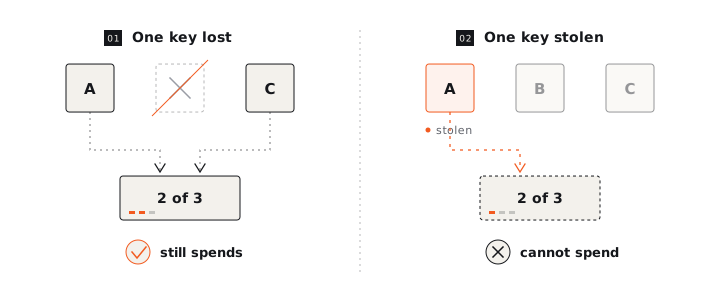
Now walk through the failures. A house fire takes the daily phone and the cold phone? Key 3 plus replacement devices restores 2-of-3 control. A burglar finds the backup seed? Alone it signs nothing, and you calmly rotate funds to a fresh wallet on your own schedule. Phone stolen at the airport? Same answer. In a 2-of-3 multisig, losing any one key is survivable and stealing any one key is worthless — the two risks that pulled against each other under a single seed are now both absorbed by the same structure.
The goal is not to make key loss impossible. It is to make any single loss survivable, and any single theft useless.
The honest costs
Multisig is not free. Every spend needs a second signature, which adds a coordination step — tolerable for savings, irritating for coffee money, which is why a small single-key hot wallet still has a legitimate place beside a multisig vault. On some chains multisig transactions cost somewhat more in fees. And you now have three seed phrases to store well instead of one; the discipline does not disappear, it decentralizes. What changes is the consequence of a mistake: an error that used to be fatal becomes a repairable incident.
There is a quieter benefit, too. Because keys can belong to different people, multisig is the natural foundation for inheritance: heirs can hold a key today without being able to spend today, and nobody ever has to share a seed phrase while alive. That deserves its own article — for now, the point stands on its own. If your entire net worth on-chain depends on one string of words staying simultaneously secret and safe, the question is not whether that arrangement can fail, but which direction it fails first.
Frequently asked questions
What happens if someone finds my seed phrase?
They control the wallet completely. A seed phrase regenerates every private key, so the finder can transfer everything to addresses they control within minutes, and on-chain transfers cannot be reversed. Moving funds to a new wallet immediately is the only defense — and only if you discover the exposure in time.
Is a metal seed phrase backup enough?
Metal solves durability — fire, flood, and fading ink — but not confidentiality or concentration. A steel plate is still a complete, spendable copy of your wallet sitting in one findable place. It is a good component of a storage plan and a poor substitute for removing the single point of failure altogether.
Does multisig mean I no longer have a seed phrase?
No — you have several. In a standard multisig, each cosigner key is its own BIP39 seed phrase, generated and stored independently. The difference is that no single one of them can spend funds or, by being lost, freeze them; only the threshold, such as 2-of-3, has that power.
Isn't a BIP39 passphrase (the "25th word") enough protection?
A passphrase protects against someone finding the written seed, which is real value. But it adds a second thing you can lose: forget the passphrase and the seed alone recovers nothing. It deepens the hiding place; it does not remove the single point of failure the way independent multisig keys do.
If you would rather change the structure than keep upgrading hiding places, Ownbit's MultiSig sets up a 2-of-3 across your phone, an offline spare handset, and a backup seed — every key a standard BIP39 phrase you could recover without our servers. The cold wallet workflow page shows the QR-based offline signing setup step by step.