

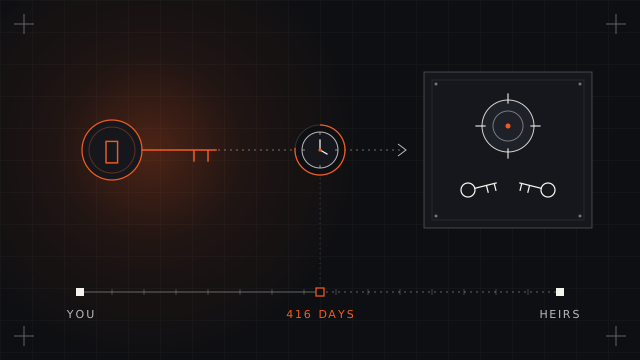
Everything that makes bitcoin worth holding also makes it hard to pass on. Keys that no bank can freeze are keys that no bank can hand to your family. A wallet that answers to nobody keeps answering to nobody after you are gone. That is the quiet paradox of self-custody, and resolving it on purpose — while you are alive and able to sign — is what bitcoin inheritance planning actually means. Without a plan, your coins do not default to the state or to your next of kin. They default to nobody, permanently.
The scale of failed bitcoin inheritance is measurable. Chainalysis has estimated that roughly 20% of all bitcoin may already be lost or stranded, much of it in wallets whose keys are gone. The most famous case: when the Canadian exchange QuadrigaCX collapsed in 2019, its founder was reported to have died as the sole holder of keys to roughly $145M in customer funds. Later investigation complicated that story considerably — but the lesson it planted stands on its own. Access that lives in one head disappears with that head.
We have already written about why the obvious shortcut fails: handing a relative your seed phrase converts a distant problem into a live risk, and the full argument is in how to pass on your crypto without sharing a seed phrase. This article is the other half — a practical, start-to-finish guide: the three tests any bitcoin inheritance plan has to pass, the real options compared honestly, and a setup you can finish in a weekend and heirs can execute decades from now.
Three tests every bitcoin inheritance plan must pass
Strip away the product names and legal jargon, and a workable plan has to do three things at once.
- It must not create a live risk today. Setting up the plan cannot put a spendable copy of your credentials into circulation. A seed phrase is not a password guarding the money; it is the money — a single point of failure in twelve words. Any plan that begins “write the words down and hand them to…” fails this test on day one.
- It must not depend on any company or court staying alive. Decades can pass between setup and execution. A plan that only works if a particular business is still online, a subscription is still paid, or a legal process moves quickly and privately imports every one of those risks into your estate.
- Your heirs must be able to actually execute it. Documented in plain language, rehearsed at least once. A mechanism nobody knows exists — or nobody has practiced — fails exactly as completely as no mechanism at all.
The options for bitcoin inheritance, honestly compared
Measured against those three tests, the field sorts quickly. Each option gets its honest pro and con.
- Doing nothing. Pro: it costs nothing and creates no new risk while you live. Con: it fails the third test completely — your family inherits a puzzle with no answer, and the coins join that stranded 20%.
- Sharing or splitting the seed phrase. Pro: free, instant, and compatible with any wallet ever made. Con: every copy is a complete, irrevocable spending credential from the day the ink dries — and splitting the words in half just means two places to burgle.
- An exchange account with beneficiary paperwork. Pro: it plugs into estate machinery lawyers already understand, with a support desk heirs can phone. Con: it is custody — the coins spend decades exposed to a company’s solvency, policy, and security, and heirs inherit an account, not keys.
- A lawyer with sealed instructions. Pro: it fits naturally alongside the will you should have anyway. Con: the sealed envelope either contains your seed — a live copy in circulation, test one failed — or it contains no key material and unlocks nothing.
- Concierge inheritance services. Casa and Unchained built this category: real multisig, human onboarding, structured recovery for heirs. Pro: genuinely strong custody with white-glove help. Con: the handover runs through the provider’s identity and death-verification process, so the plan leans on that company staying in business — we compared the two models in Casa vs Ownbit for crypto inheritance.
- Wallet-native multisig with an inactivity timer. Pro: heirs hold their own keys from day one, and the handover is enforced by code and protocol rather than by paperwork or promises. Con: it asks the most of you up front — the setup, the documentation, and the rehearsal are yours to do.
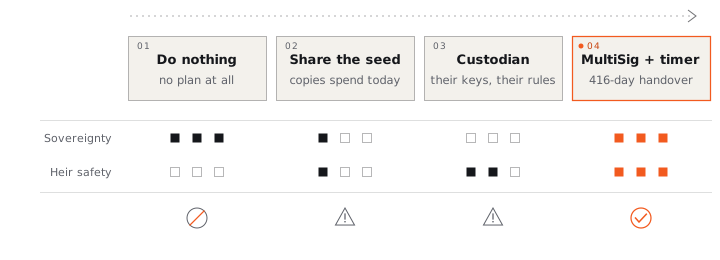
The rest of this guide walks through that last option in concrete steps, using Ownbit’s Inheritance MultiSig as the implementation.
The Ownbit plan, step by step
Step 1 — pick a structure. Three shapes cover most families. A 2-of-2 with accident protection is the simplest: two keys, both required to spend; you hold both to begin with, and one goes to your heir. A 2-of-3 is the standard family arrangement: you, your spouse, and an adult child each hold one key; any two signatures spend. A 3-of-4 with accident protection suits larger families: four keys spread across the household, three needed to move funds.
Step 2 — give every participant their own key. In an Ownbit multisig, each key is its own standard BIP39 seed phrase, generated on that person’s own phone and backed up on paper by that person alone. Nobody ever reads anyone else’s words — which is precisely what keeps the first test intact. Families that already co-sign day to day with Family MultiSig have a head start here: the signing habits a household builds while everyone is healthy are the same habits an inheritance depends on later.
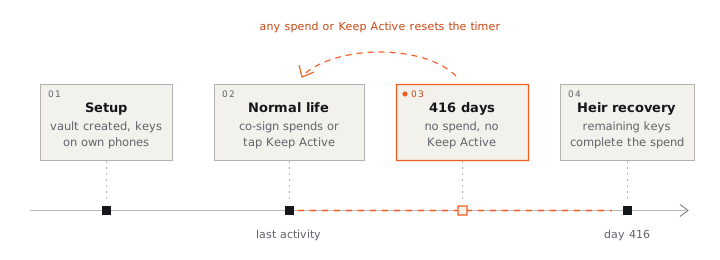
Step 3 — let the chain enforce the handover. Every Ownbit inheritance vault carries a 416-day inactivity condition. On Ethereum and other EVM chains, the vault is an accident-protection smart contract and the rule lives in open-source code you can read before depositing anything. On chains that cannot run that logic natively — Bitcoin, TRON, Solana — Ownbit joins the wallet as an assisting co-signer: a 2-of-2 is created on-chain as effectively a 2-of-3, and a 3-of-4 as effectively a 3-of-5. Ownbit’s signature is only ever added after the 416-day condition is met, and one signature can never satisfy a threshold on its own, so Ownbit can never move funds alone.
Step 4 — live normally. While you are active, the timer is invisible. Any successful spend automatically refreshes the active status of everyone who signed it, and if the vault sits quiet, opening the app and tapping Keep Active resets the clock in one tap. 416 days is nearly fourteen months of margin; two calendar reminders a year is plenty.
One vault also covers more than bitcoin. The same structure spans BTC alongside ETH, BSC, TRX, SOL, BASE, ARB, MATIC, BCH, LTC, and DOGE — so your bitcoin inheritance plan and your broader crypto inheritance plan can be one object your heirs learn once, not a drawer of separate systems.
The paper part: a letter of instruction
A mechanism without a map still fails the third test, so write the map. One page is enough: name the app (Ownbit), the chains the vault covers, who holds a key and on which phone, and the steps heirs should take — open the app, wait out the timer if it is running, follow the recovery flow, contact the other signers. The letter contains zero seed words, which is exactly why it is safe to store with your will: anyone who reads it learns the plan and gains no spending power at all. Estate law still matters — wills, probate formalities, and tax vary by jurisdiction and belong with a professional — but the letter is what connects your legal intent to actual access. If you want to leave bitcoin to your family rather than to chance, this single page does surprisingly heavy lifting.
Rehearse it while you’re alive
Fund the vault with a small test amount first and run one complete co-signed spend, so every participant has performed the ceremony once. Then have each heir open the app on their own phone, find their key, and read the letter — ten minutes that convert a future crisis into a checklist. Revisit the plan when life changes: phones get replaced, people move, families grow. Rotating a participant is an ordinary co-signed migration while you are alive — and impossible to organize after.
Bitcoin inheritance planning checklist
- Choose a structure: 2-of-2 with accident protection, 2-of-3, or 3-of-4.
- Each participant installs Ownbit and generates their own seed phrase on their own phone, backed up on paper and stored separately.
- Create the vault and verify the receiving address on every participant’s device before funding it.
- Send a small test amount and complete one full co-signed spend.
- Fund the vault and set two Keep Active reminders a year.
- Write the letter of instruction — zero seed words — and file it with your will.
- Walk your heirs through it once, and revisit when the family changes.
Frequently asked questions
How do I leave bitcoin to my family?
Give family members their own keys in a shared multisig vault instead of copies of your seed phrase. In an Ownbit inheritance vault, heirs hold real keys from day one but cannot meet the signature threshold while you are active; after 416 days of your inactivity, the recovery path opens and they can take over. Pair the wallet with a plain-language letter of instruction — containing no seed words — stored with your will.
What happens to my bitcoin if I die without a plan?
Nothing moves — and that is the problem. The network keeps enforcing your keys forever, so without them your family cannot spend, no matter what documents they hold. A court can rule that the coins belong to your heirs and still be unable to move them. In practice, unplanned coins tend to join the roughly 20% of bitcoin that is estimated to be lost for good.
Does bitcoin go through probate?
In most jurisdictions bitcoin is treated as property of your estate, so legal title generally passes through the normal probate process and taxes may apply. But probate only transfers ownership on paper — it cannot produce keys. That is why a complete bitcoin inheritance plan has two layers: a will that settles who should receive the coins, and a key arrangement that lets them actually take custody. Rules differ widely between jurisdictions, so treat this as background, not legal advice.
Do my heirs need to be technical?
No. Each heir needs to keep one phone and one paper backup safe, and follow a short, rehearsed procedure — the app walks them through recovery step by step. The strongest predictor of success is not technical skill — it is a practice run done while you were there to answer questions.
Is this only for bitcoin?
No. The same vault covers ETH, BSC, TRX, SOL, BASE, ARB, MATIC, BCH, LTC, and DOGE alongside BTC, with the same 416-day handover — one crypto inheritance plan for the whole portfolio instead of a separate arrangement per chain.
Bitcoin inheritance planning is never urgent until it is suddenly impossible — and the whole setup takes an afternoon plus one family conversation. Ownbit’s Inheritance MultiSig builds the vault on iOS or Android, every new user gets a 7-day free trial, and the keys are yours regardless of membership.