

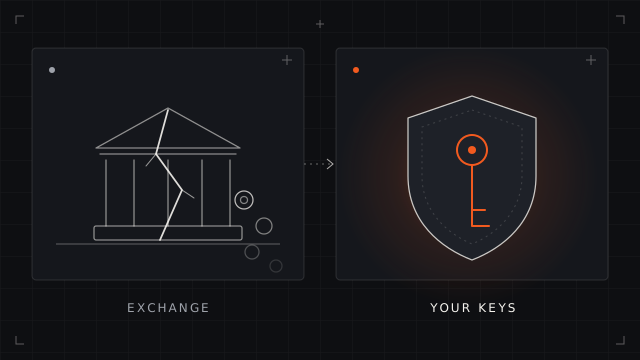
One year ago this week, FTX went from being one of the largest crypto exchanges in the world to a bankruptcy court in the space of about ten days. Withdrawals froze in early November 2022; the Chapter 11 filing landed on November 11; and widely reported estimates soon put the shortfall in customer funds at roughly $8 billion. Last week, on November 2, Sam Bankman-Fried was convicted on fraud charges. The verdict settled the question of blame. It did nothing for the customers, who remain creditors in a bankruptcy case rather than owners of their coins.
“Not your keys, not your coins” is often dismissed as a slogan, but it is a precise statement about how crypto ownership works: whoever controls a wallet's private keys controls its funds, and a balance on an exchange is a claim against a company, not coins on a blockchain. A year after FTX made that distinction brutally concrete, it is worth spelling out what the phrase means in practice — and being honest about what self-custody asks of you in return.
What a year of bankruptcies actually taught
FTX was not an isolated event. Celsius and Voyager filed for bankruptcy in mid-2022; BlockFi followed within weeks of FTX. Every one of these collapses ran the same sequence: rumors, a surge of withdrawal requests, a freeze, and then a filing. By the time customers understood there was a problem, the door was already shut.
The uncomfortable lesson is structural, not moral. When you deposit coins with a custodial platform, the coins move to addresses the platform controls, and in practice your deposit becomes part of the company's working assets. If the company lends, stakes, or simply loses those assets, your recourse is a legal process, not a cryptographic one. In bankruptcy, exchange customers are generally treated as unsecured creditors — near the back of the line, often waiting years. Mt. Gox collapsed in 2014, and its creditors were still waiting for distributions nearly a decade later. As of this writing, FTX's customers have been waiting a year, with no fixed date for recovery and no certainty about how much will come back.
None of this requires assuming every exchange operator is dishonest. Most are not. It only requires noticing that this failure mode exists, that it has now occurred repeatedly, and that it is invisible from the outside until it is too late to act.
What “not your keys, not your coins” means, precisely
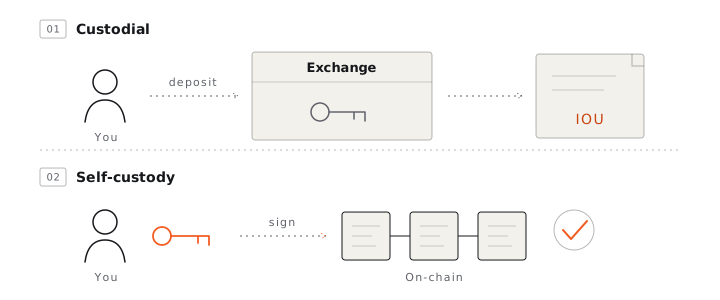
On a blockchain, ownership is not a name in a registry; it is the ability to sign transactions. An exchange balance is an IOU: a database entry recording that the company owes you coins it holds — or is supposed to hold — on your behalf. The blockchain itself has no record that you exist. When you tap “withdraw,” you are not moving your coins; you are asking the company to send some of its coins to you, and it can decline.
Self-custody inverts this. Self-custody means holding the private keys to your assets yourself, so that no exchange failure, withdrawal freeze, or fraud can touch them. The trade is straightforward: with a custodian you carry counterparty risk, and with your own keys you carry operational risk — the risk of losing, exposing, or mishandling the keys. “Not your keys, not your coins” does not claim that self-custody is effortless. It claims the two risks are different in kind, and that you should pick one deliberately instead of defaulting into the custodial one because a trading app happened to be the first thing you installed.
The honest case for custodians
A serious version of this argument has to concede what custodians are good at. If you trade actively, you need an order book, and you will keep a balance on an exchange. Fiat on-ramps and off-ramps run through regulated companies almost by definition. Institutions often have compliance obligations that require a qualified custodian. And some holders — through age, circumstance, or preference — genuinely should not be responsible for a seed phrase.
The practical rule most people land on is a float-and-vault split: keep on an exchange only what you are actively trading, the way a shop keeps a small float in the till, and hold long-term positions where a company failure cannot reach them. FTX's customers were not wrong to use an exchange; many were simply using a trading venue as a savings account without ever having made that decision consciously.
What self-custody actually asks of you
Taking your keys means accepting that you are now the security department. Most self-custody losses have nothing to do with sophisticated attackers: they are backups that never existed, seed phrases photographed and synced to a cloud account, paper notes lost in a house move, or holdings nobody's family could locate after an accident. A single seed phrase is a single point of failure — one string of words that an attacker, a fire, or plain forgetfulness can take from you — and we have written before about why that single point of failure is the real weakness of most self-custody setups.
It also means deciding what you trust, consciously. The backlash over Ledger's Recover service earlier this year showed that even dedicated self-custody products can surprise their users about what the vendor is technically able to do; the lesson we took from that episode is to prefer designs you can verify over reputations you have to trust. Keys should follow open standards, recovery should not depend on any single company staying in business, and the critical logic should be inspectable.
MultiSig: self-custody without a single point of failure
The strongest answer to the operational risk of self-custody is to remove the single point of failure entirely. A multisig wallet requires signatures from multiple independent keys — two of three, for example — before any funds can move. One key lost is an inconvenience, not a catastrophe: the remaining keys can still spend. One key stolen is a failed attack, not a theft: the thief cannot reach the threshold alone.
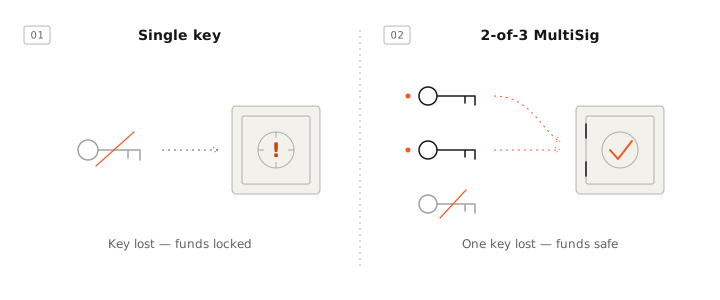
This is the model Ownbit's MultiSig has run on since 2017. Every participant in an Ownbit multisig holds a standard BIP39 seed phrase, the multisig contracts are open source, and Ownbit's servers coordinate signing without ever holding a key — recovery remains possible without Ownbit at all, using published self-recovery guides. For the cold-storage layer, a spare phone can act as an air-gapped signer: it stays offline permanently, receives unsigned transactions as QR codes, and returns signatures the same way, so no key ever touches an internet-connected device.
A practical first week of self-custody
If the anniversary is your prompt to act, a deliberate first week looks like this:
- Start with a test. Create a wallet, record the seed phrase on paper — never in a screenshot or a cloud note — and withdraw a small amount from your exchange to it. Verify that it arrives.
- Rehearse recovery. Wipe the test wallet and restore it from the paper backup before real money depends on it. A backup you have never tested is a hope, not a backup.
- Upgrade to multisig for meaningful amounts. Set up a 2-of-3 wallet with keys on separate devices in separate places, so that no single device, location, or person can sink you.
- Leave only your trading float behind. Whatever remains on an exchange should be an amount whose total loss you could shrug off.
- Write it down for someone else. Document what exists and how to recover it, so your holdings do not die with your memory.
None of these steps is technically difficult. What they require is the decision FTX's customers never got to make in time: choosing, while everything is still calm, who actually controls your coins.
Frequently asked questions
What does “not your keys, not your coins” mean?
It means that whoever controls a wallet's private keys controls its funds. Coins deposited on an exchange sit in addresses the exchange controls; your account balance is a database entry — a claim against the company — not coins on a blockchain. If the company freezes withdrawals or fails, that claim is all you have.
Is it safe to keep crypto on an exchange?
It is a counterparty risk, not a guaranteed loss. Reputable exchanges serve active traders well, but FTX, Celsius, Voyager, and BlockFi all froze withdrawals with little warning within a single year. A common rule is to keep on an exchange only what you actively trade and to hold long-term positions in self-custody.
Will FTX customers get their money back?
As of this writing, the bankruptcy is still in progress and no distribution date is fixed. Customers are unsecured creditors, and comparable cases have taken years — Mt. Gox creditors were still waiting nearly a decade after its 2014 collapse. How much will ultimately be returned remains uncertain.
Is self-custody riskier than leaving coins on an exchange?
It carries a different risk, not necessarily more of it. A custodian exposes you to company failure; self-custody exposes you to your own mistakes, such as losing a seed phrase. Multisig with tested backups removes most of that operational risk, because no single lost or stolen key can cost you the funds.
If you have been meaning to take custody of your own keys since last November, the mechanics are simpler than a year of headlines suggests. Ownbit's secure self-custody setup turns a spare phone into an offline signer with nothing extra to buy, and Ownbit MultiSig lets you hold the result behind multiple keys instead of one — with a 7-day free trial, and your keys remaining yours regardless of membership.