

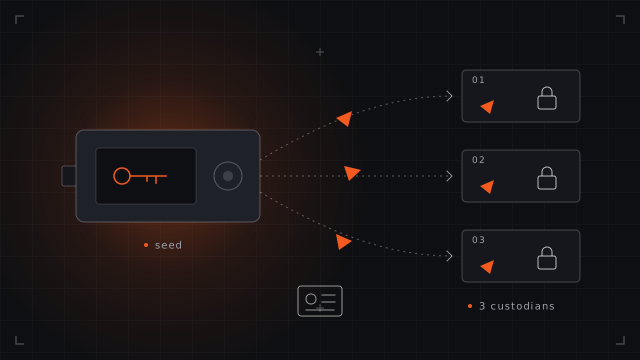
On May 16, Ledger — maker of the best-selling hardware wallets — announced Recover: an opt-in subscription that backs up your seed phrase by encrypting it inside the device, splitting it into three shards, and sending those shards to three custodians. Within hours the announcement had become the Ledger Recover controversy, one of the sharpest backlashes self-custody has produced in years, complete with deleted tweets, hastily arranged interviews, and, ultimately, a paused launch. Three weeks on, with tempers slightly cooler, it is worth asking what the episode actually proved.
Our answer, stated up front: the fight was never really about one optional service. It was about the public collapse of an assumption — that private keys physically could not leave a hardware wallet's secure element — which turned out to be a policy rather than a law of nature. Security you cannot verify is a promise, and a promise can change with a firmware update.
What Ledger Recover actually does
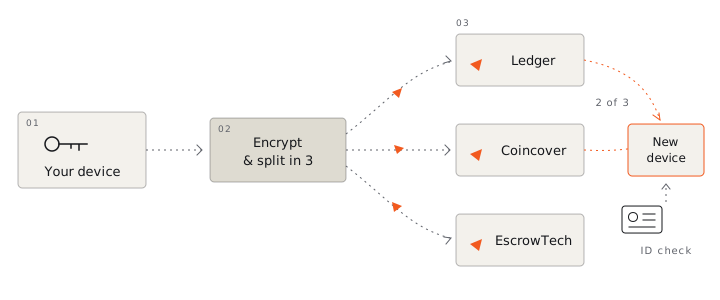
Strip away the outrage and the mechanics are easy to state. Ledger Recover is an opt-in subscription service, priced at roughly $10 a month, that encrypts a wallet's seed phrase inside the device, splits the encrypted material into three shards, and distributes them to three separate companies: Ledger itself, Coincover, and EscrowTech. No single custodian holds enough information to reconstruct the seed. To restore, a user verifies their identity with a government ID; two of the three custodians then release their shards to a new device, where the seed is reassembled.
The service arrived alongside a firmware update for the Nano X and requires explicit enrollment: nothing is backed up unless the owner subscribes, confirms on the device, and passes identity verification. Ledger has been consistent on that point throughout, and no public evidence contradicts it.
Why the backlash was so fierce
If the service is optional, why the fury? Because the announcement revealed a capability, not just a product. For Recover to exist at all, Ledger's firmware must be able to move seed material — encrypted and sharded, but seed material nonetheless — out of the secure element and off the device. A large share of Ledger's customers believed, in good faith, that this was impossible by design, and the company's own marketing had encouraged the belief: a months-old post from an official account stating that private keys never leave the secure element resurfaced within hours and was shared relentlessly.
The defining moment of the Ledger Recover controversy came when one of Ledger's official accounts acknowledged that it had always been technically possible to write firmware that facilitates key extraction. The post was soon deleted, but the screenshots were everywhere — and the statement was accurate. That is precisely what stung: not a hidden backdoor, but the realization that the barrier between a user's keys and the outside world had always been a matter of what signed firmware chooses to do.
Two further concerns amplified the reaction. Identity, first: Recover ties a verified government ID to a hardware wallet, an uncomfortable pairing for people who chose self-custody partly for privacy. Concentration, second: three named companies holding shards are three subpoena targets, three breach surfaces, and three places where a future change of policy could matter.
You were always trusting the firmware
Here is the uncomfortable part, and it extends well beyond one vendor. A secure element protects keys against physical extraction and tampering; it does not decide what the device's firmware is allowed to request from it. Any closed device that generates and holds your keys asks you to trust its manufacturer's code-signing keys, release process, employees, and resilience to legal pressure — for every year the device stays in use.
Self-custody is not a binary; it is a stack of trust assumptions — hardware, firmware, software, and process — and the useful question is which layers you can independently verify. Nothing about May's events changed that stack. What changed is that a very large audience saw it clearly for the first time.
We should be plain about where we stand in that stack ourselves. The Ownbit app is closed source, like most wallet apps. The honest response to that reality is not to pretend the trust away but to shrink what it has to cover, which is how our security model is built: the multisig contracts are open source, every key in an Ownbit multisig is a standard BIP39 seed phrase, and funds remain recoverable without Ownbit's servers by following published self-recovery guides. The measure of a wallet is not whether you trust the vendor — you do, somewhere — but how little that trust must cover and how much of it you can check.
The problem Recover wants to solve is real
It would be easy, mid-pile-on, to forget that Ledger is aiming at a genuine failure mode. Widely reported estimates have long suggested that something like a fifth of all bitcoin sits stranded in wallets whose keys are lost. A seed phrase on a single sheet of paper is a single point of failure in both directions: anyone who finds it can take everything, and if it burns, floods, or is simply forgotten, everything is gone with it. Exchanges solved this with accounts and support desks, at the cost of custody — a trade the industry has repeatedly had cause to regret.
So the ambition deserves fairness. Hardware wallets, MPC services, and regulated custodians each serve real users with real needs, and an insured recovery service will genuinely fit some of them. The objection at the heart of the Ledger Recover controversy is narrower: the service quietly rewrote the trust model of a device people had already bought, and the rewrite cannot be independently audited while the firmware stays closed.
Splitting a secret is not splitting control
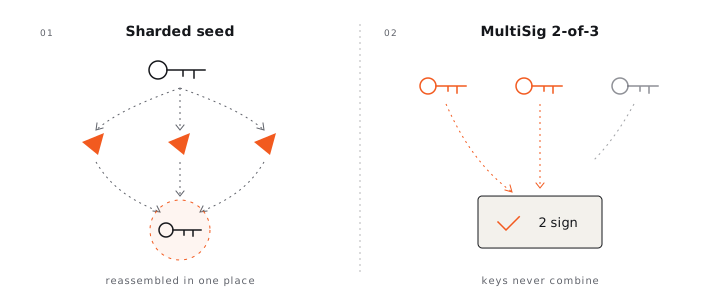
Recover's three-shard, two-to-restore design sounds superficially like multisig. The difference is the whole point. Seed sharding splits one secret that must eventually be reassembled: at the moment of recovery the full key exists in one place again, and everything rides on the parties and process doing the reassembly. Multisig splits control itself. Two or three independent seed phrases, generated on separate devices by different people, never combine anywhere; a 2-of-3 wallet needs two signatures on-chain, and there is no ceremony in which one machine briefly holds everything.
That distinction is why MultiSig has been Ownbit's core design since 2017. Each participant keeps a standard BIP39 seed phrase, signing rules are enforced by the blockchain rather than by a company's word, and Ownbit's servers coordinate signatures without ever holding a key. Losing one key is survivable, stealing one key is useless, and no custodian — including us — stores anything that can move funds.
What to take away, as of June 2023
First: no panic is warranted. Nothing in these three weeks demonstrated an exploit, a theft, or a broken device, and an unenrolled Ledger faces the same practical risks it faced in April. If you own one, the sensible responses are calm ones — apply firmware updates deliberately, and re-examine what you are trusting rather than reacting to what you are told.
Second: inventory your trust assumptions while the lesson is fresh. Which parts of your setup are promises, and which are verifiable? A useful exercise is to ask, for each wallet you use, what its vendor could do — not would, could — and whether you would find out if it did.
Third: for balances that matter, stop depending on any single key or any single company. Spreading control across a 2-of-3 multisig removes the single point of failure that Recover targets, without handing any custodian a reconstructable copy of your seed. As of this writing Ledger has paused the Recover rollout and committed to open-sourcing more of its code before launch — the right direction, and one that should be judged the way everything in this industry should be judged: by what is verifiable when it ships. The lasting lesson of the Ledger Recover controversy is that the distance between "cannot" and "will not" is the entire subject of self-custody, and users are entitled to know which one they bought.
Frequently asked questions
What is Ledger Recover?
Ledger Recover is an opt-in subscription service, announced by Ledger on May 16, 2023, that backs up a hardware wallet's seed phrase. The device encrypts the seed, splits it into three shards, and distributes them to three custodians — Ledger, Coincover, and EscrowTech. Restoring requires government-ID verification and shards from two of the three custodians.
Is Ledger Recover a backdoor?
Not in the usual sense: it is optional and requires enrollment, a subscription, and physical confirmation on the device. The controversy arose because the feature demonstrated that Ledger's firmware can export encrypted seed material from the secure element at all — meaning the protection many users assumed was physical is actually a firmware policy.
Are Ledger hardware wallets still safe to use?
No exploit, theft, or vulnerability was demonstrated during the episode, and a device that never enrolls in Recover behaves as it did before. What changed is the trust model users should assume: a closed-firmware device is exactly as trustworthy as its vendor's code and processes. Many holders will judge that acceptable; others will spread their risk with multisig.
What is the self-custodial alternative to seed recovery services?
The main alternative is multisig. A 2-of-3 multisig wallet spreads control across three independent seed phrases held on separate devices, so losing one key does not lose the funds and no company ever holds a reconstructable copy of the seed. It addresses the same accident-recovery problem without a custodian or identity verification.
If the past few weeks have you re-checking where your own trust is concentrated, the practical next step is to stop relying on any single key — or any single company. Ownbit MultiSig lets you split control across standard seed phrases you hold yourself, with open-source contracts and a security model designed so funds stay recoverable even without our servers. It is a calmer place from which to watch the next controversy.