

If your business holds or moves meaningful amounts of USDT, the odds are that it happens on TRON. TRC-20 USDT has been the workhorse of stablecoin settlement for years: its supply overtook USDT on Ethereum years ago, the network carries more than $60 billion of the token as of this writing, and by most widely reported measures the majority of all USDT transfers settle on TRON. Exchanges credit it by default, OTC desks quote it, and payroll across much of Asia, Africa, and Latin America arrives as TRC-20.
That concentration is exactly why a TRON multisig wallet deserves more attention than it usually gets. TRON is unusual among major chains: multisig is not a smart contract you deploy but a property of every account, enforced at the protocol level through weighted keys and thresholds. The cryptography, in other words, is the easy part. What decides whether a treasury is both safe and usable is everything around it — who holds keys, what weights and thresholds those keys carry, how a payout actually flows on a Tuesday afternoon, and what happens when a signer leaves the company. This article is a working blueprint for those decisions.
Why stablecoin treasuries end up on TRON
Three properties explain the pull. Liquidity first: because most counterparties — exchanges, OTC desks, payment processors — already accept TRC-20 USDT, settling on TRON means never asking the other side to bridge, swap, or wait. Second, speed: TRON produces a block roughly every three seconds, so a transfer typically confirms in under a minute. Third, cost predictability: TRON prices transactions in bandwidth and energy, resources an account can acquire by staking TRX, rather than through a volatile gas auction. A treasury that stakes for its own energy knows its settlement costs weeks in advance, which matters when you run a payout batch every Friday.
The consequence is that companies run real operations through TRON accounts: weekly payroll, supplier settlement, exchange float management, remittance batching. Amounts that would justify a vault and a controller in the fiat world routinely sit behind a single private key on TRON. That is the gap a multisig treasury closes — and TRON gives you unusually good raw material to close it with.
TRON multisig is native to the protocol
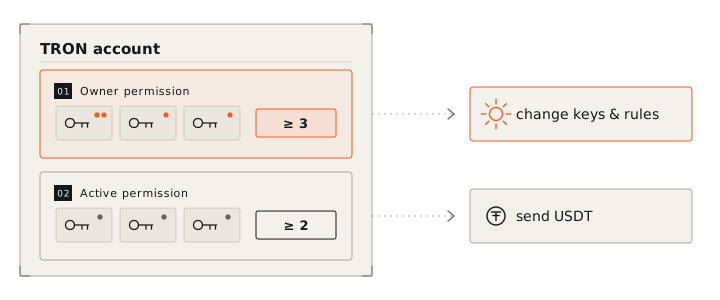
Most chains bolt multisig on. On Ethereum, a multisig is a smart contract that holds the funds and counts approvals — battle-tested, but an extra layer of code between you and your assets. On Bitcoin, it is a script encoded into the address. TRON took a third route and built the feature into accounts themselves. Every TRON account has an owner permission and up to eight active permissions, and each permission contains up to five weighted keys plus a signing threshold. A transaction is valid only when the combined weight of the signatures attached to it meets the threshold of the permission it invokes. Every node checks this rule as part of consensus. There is nothing to deploy and no contract to audit.
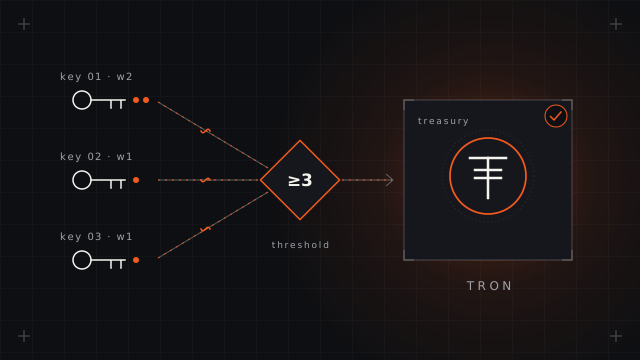
The two permission types divide labor cleanly. The owner permission is the master right: it can reconfigure the account itself, including replacing keys, changing weights, and adjusting thresholds. Active permissions are scoped for daily work, such as calling the USDT contract to make a transfer. Weights add a nuance that plain m-of-n schemes lack: one key can carry weight 2 while others carry weight 1, so a threshold of 3 can mean "the CFO plus any one operator, or three operators together" — a policy, not just a count.
A TRON multisig wallet, then, configures machinery the network already provides. Ownbit's TRON MultiSig is built directly on these native permissions; each participant's key is a standard BIP39 seed phrase that stays with its holder, so the setup remains recoverable with or without Ownbit's servers.
Roles and thresholds that survive real operations
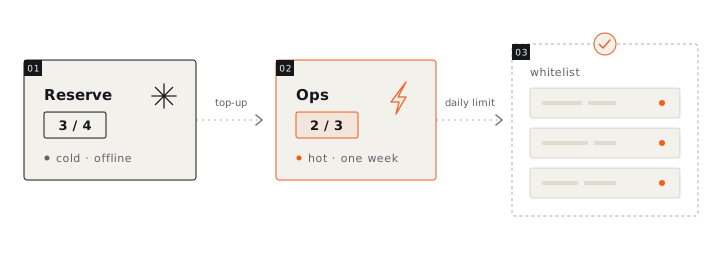
The structure we recommend for a stablecoin treasury is two wallets with different temperaments.
- A cold reserve that holds most of the float. Use a higher threshold — 3-of-4 is a sensible floor, 4-of-5 where more officers are available — and keep its keys offline. In Ownbit, a spare phone becomes an air-gapped signer: unsigned transactions travel in by QR code and signatures travel out the same way, so reserve keys never touch a networked device. The reserve should send to exactly one destination: the operations wallet.
- A hot operations wallet holding roughly a week of payouts at 2-of-3. Low enough friction that the team actually uses it, small enough that a worst-case compromise is an incident rather than an obituary.
Weighted keys let the thresholds encode policy. Give the finance lead weight 2 and two operations staff weight 1 each, with a threshold of 3: the lead plus either operator can pay, the two operators cannot act without the lead, and no individual can pay alone. On the reserve, flip the logic — equal weights, higher threshold — so that no single officer, however senior, meets the bar with only one colleague.
Ownbit's Enterprise MultiSig layers organizational roles on top: an Owner who administers the wallet, Signers who approve, and a Security Admin who manages guardrails without being able to spend. A web console gives the finance team a desk-sized view of pending approvals instead of a queue squinted at on phones. The principle underneath all of it is separation: the person who proposes a payment should never be able to approve it alone.
A treasury is well designed when the fastest way to move money is also the safe way.
Daily operations: whitelists, limits, and batch runs
Thresholds control who can pay; the next layer controls where and how much. An address whitelist restricts outgoing transfers to pre-approved destinations, so even a full quorum of compromised signers cannot pay an address the company has never vetted. Make whitelist changes deliberately more expensive than payments — a higher approval bar, ideally with a waiting period — because an attacker who can edit the whitelist owns the treasury.
Daily and monthly spending limits cap the blast radius of any single bad day. Batch signing keeps all of this workable at volume: a payroll run of eighty transfers becomes one review session in which the quorum checks the batch and signs once, instead of eighty separate approval ceremonies that train signers to stop reading.
Two TRON-specific habits round out the routine. Stake TRX for energy on the paying account, so USDT transfers draw on your own resources at predictable cost instead of burning fees at posted rates. And verify full addresses, not the first and last four characters: address-poisoning attacks — where an attacker seeds your transaction history with lookalike addresses via tiny or zero-value transfers — have been widely reported on TRON precisely because treasury payments there are so routine. A whitelist plus full-address verification defeats them.
The failure modes to design against
The February 2025 Bybit incident is the cautionary tale for every multisig operator. Attackers took roughly $1.5 billion not by breaking cryptography but by compromising the signing interface, so signers approved a transaction that did something very different from what their screens displayed. We wrote up the mechanics in our analysis of the Bybit hack; the short version is that a multisig is only as strong as the weakest screen a signer trusts. The countermeasure is independent verification: at least one signature should come from a device that decodes the raw transaction itself. Ownbit's QR-based offline signing does exactly this, showing the parsed transfer on an air-gapped phone before it signs.
The second failure mode is quieter: a misconfigured owner permission. Teams sometimes build a careful 3-of-4 active permission for payments and leave the owner permission on a single founder key. That key can rewrite every rule, so the whole treasury silently reduces to one point of failure. Put the owner permission under a threshold at least as strict as the reserve's.
Third, people leave. Here TRON is genuinely kind to operators: because permissions live on the account, a departing signer's key can be rotated out with a permission update — approved by the owner threshold — without moving funds or changing the deposit address your counterparties have whitelisted on their side.
Finally, people die, and a treasury key in a deceased colleague's safe is a real operational risk. We covered the personal version in how to pass on crypto without sharing a seed phrase; for TRON treasuries, Ownbit's accident protection can add itself as an assisting co-signer that only becomes able to co-sign after 416 days of a participant's inactivity — and can never move funds alone.
Frequently asked questions
Does TRON support multisig natively?
Yes. Multisig on TRON is a protocol feature, not a smart contract: every account has an owner permission and up to eight active permissions, each holding weighted keys and a signing threshold that every node enforces. A TRON multisig wallet such as Ownbit configures these native permissions rather than deploying extra code.
What signature threshold should a USDT treasury use?
A common structure is 2-of-3 on a hot operations wallet and 3-of-4 or stricter on a cold reserve. Avoid 1-of-n, which is not multisig at all, and be cautious with n-of-n, where a single lost key freezes funds permanently. Weighted keys let you encode role-based policies beyond simple counts.
Does multisig make TRON USDT transfers more expensive?
Not meaningfully. TRON charges for bandwidth and energy rather than running a per-signature gas auction, and a USDT transfer from a multisig account consumes roughly the same resources as one from a single-key account. Treasuries typically stake TRX for energy, which keeps per-transfer costs low and predictable.
Can we change signers without moving funds?
Yes. Because permissions are attached to the TRON account, a permission-update transaction approved by the owner threshold swaps keys, weights, or thresholds in place. The account address stays the same, so counterparties' whitelists and deposit records remain valid.
If you are building this kind of setup, Ownbit's TRON MultiSig wallet implements native weighted permissions from the phones your team already carries, and Enterprise MultiSig adds the operational layer — Owner, Signer, and Security Admin roles, address whitelists, spending limits, batch signing, and a web console. Every key remains a standard seed phrase in its holder's hands, Ownbit's servers coordinate signatures but never hold keys, and every new user gets a 7-day free trial to model the structure before committing real float.