

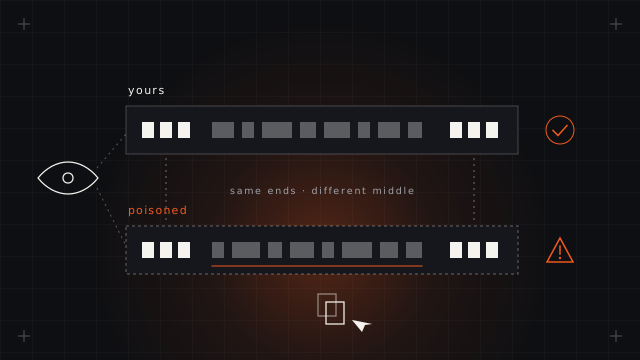
In May 2024, one of the most expensive copy-paste mistakes in crypto history sent roughly $68 million of Wrapped Bitcoin to a stranger. No seed phrase was stolen and no smart contract was exploited. The victim copied an address out of their own transaction history — an address an attacker had planted there, engineered to look identical to one the victim already trusted. That is the address poisoning scam, and it is one of the cheapest, most scalable attacks running today.
The scam works because of a habit nearly every crypto user shares: verifying an address by its first and last few characters. Wallets and block explorers truncate long addresses for display, so the habit feels natural — and attackers can manufacture look-alikes that match those visible ends for almost nothing. The fix is not "look harder." It is changing how addresses enter your wallet at all: verified contacts, whitelists, QR codes, and full-address checks instead of glances at a history list.
What an address poisoning scam actually is
Address poisoning is a scam in which an attacker generates a look-alike address matching the first and last characters of an address you genuinely use, plants it in your transaction history, and waits for you to copy the wrong entry. No permission from you is needed at any step. The attacker watches public chain data for wallets that move meaningful value on a routine — treasury payouts, exchange deposits, recurring settlements — and picks the counterparty addresses those wallets send to most often.
Manufacturing the look-alike is the easy part. Vanity-address generators grind random keys until one produces an address with the desired characters in the desired positions. Matching an entire address is computationally impossible, but matching four to six characters at each end is cheap enough that attackers do it in bulk, on commodity hardware, against thousands of targets at once. The result is a real address the attacker fully controls — one that happens to be indistinguishable from your counterparty's address in every truncated display.
How a fake entry gets into your history
The look-alike is useless until it appears somewhere you might copy it from. Three delivery methods dominate:
- Dust transfers. The attacker sends a tiny amount — a few cents or less — from the look-alike address to yours. Your wallet now shows an incoming transaction from an address that looks exactly like your regular counterparty.
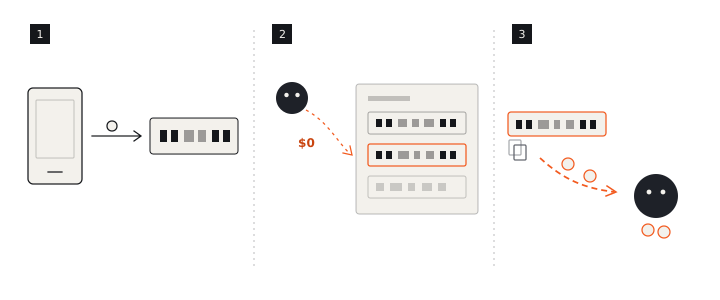
- Zero-value token transfers. On EVM chains and TRON, token contracts will process a transfer of zero tokens from anyone. A zero-value transfer requires no approval from the wallet it appears to come from, because moving zero tokens never exceeds any allowance. The attacker triggers one so that an outgoing transfer of 0 USDT appears in your own history, from your address to the look-alike — a transaction you never made, that cost you nothing, and that looks exactly like your last real payment.
- Fake token airdrops. Worthless tokens carrying familiar tickers arrive from the look-alike address, seeding both your history and your notifications.
All three leave the same trap behind: an entry whose visible characters match a destination you trust. Then the scam goes dormant — sometimes for months — until the day you are in a hurry.
The $68 million paste
The May 2024 case that made the address poisoning scam famous followed the script exactly. A whale wallet made a small transfer to a new address. Within minutes, an attacker generated a look-alike matching the first and last characters of that destination and dropped a fake entry into the wallet's history. On the next transaction the victim copied the poisoned entry and sent roughly $68 million in WBTC to it. The entire attack had cost the scammer little more than transaction fees.
What happened next was the unusual part: after days of on-chain messages and negotiation, the attacker returned essentially all of the funds. The victim was lucky — the sheer size of the haul, the publicity, and the tracing pressure that followed made cashing out dangerous. Do not build your threat model on that ending. Poisoning campaigns run continuously against ordinary wallets for far smaller amounts, and smaller victims do not get their money back.
Why your eyes fail — and habit makes it worse
An EVM address is 42 characters long; a TRON address is 34. Interfaces truncate them to a handful of characters at each end, and years of using those interfaces train you to treat the ends as the address. Attackers know the exact truncation patterns of popular wallets and explorers, and they match precisely those characters. When both visible ends agree, the middle — the only part that differs — is the part no display shows and no habit checks.
This is the same class of failure that produced far larger losses at the institutional level. In February 2025, the Bybit incident showed that even a major exchange's multisig signers approved what a compromised interface displayed rather than what was actually being signed — we examined that failure in our analysis of the Bybit hack. The address poisoning scam is the retail edition of the same truth:
Address poisoning never touches your keys. It edits the environment your keys act in — then lets you sign a perfectly valid transaction to the wrong place.
That is also why the blockchain itself cannot save you. The transaction you sign is exactly the one you asked for; it is your intent that was corrupted upstream. Once confirmed, it is final.
Defenses that actually work
Because the scam exploits workflow rather than cryptography, the effective defenses are workflow changes — ranked here from most structural to most manual:
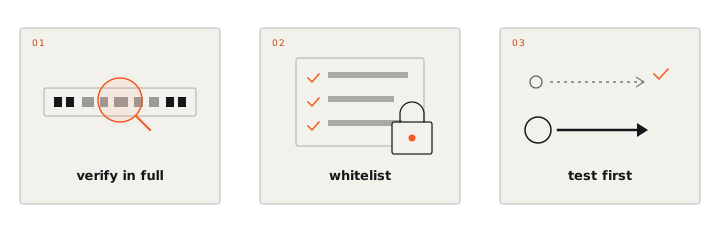
- Never copy addresses from transaction history. Treat history as a display, not a source. The only safe sources are a contact you saved at a verified moment, a QR code scanned directly from the recipient, or an address delivered over a live, separate channel.
- Use whitelists where the stakes justify them. An address whitelist restricts outgoing transfers to a pre-approved list of destinations, which makes a poisoned entry unusable even if someone pastes it. Ownbit's security model supports address whitelists in Enterprise MultiSig, alongside daily limits and signer thresholds, so one person's paste cannot move treasury funds to an unvetted address.
- Verify the full address once, then trust only the saved contact. Checksums catch typos, not look-alikes — a poisoned address is a perfectly valid address. Compare every character against what the recipient sent you, or read the middle of the string aloud over a call. Do it once, save the contact, and never re-copy it from anywhere else.
- Send a test amount first — and confirm receipt out-of-band. A small transfer costs one fee and removes the tail risk from a large one. But have the recipient confirm arrival through a separate channel; confirming it yourself by glancing at history reopens the same trap.
- Put a second screen, or a second person, in the loop. Ownbit's cold wallet workflow moves the unsigned transaction by QR code to an offline phone, where the full destination is reviewed on hardware the online environment cannot touch. In a multisig, a co-signer on a different device re-checking the destination turns one person's paste error into a rejected proposal instead of a loss — provided signers actually verify, which is exactly the discipline the Bybit case showed can decay.
Hardware wallets deserve an honest mention here: their on-device display serves the same purpose as an air-gapped phone, and they help against poisoning exactly to the degree their owner reads the full address on the device. No tool verifies your intent for you.
A 30-second ritual for any large transfer
- Get the destination from the recipient through a live channel — chat, call, or QR code — never from your history.
- Save it as a named contact immediately; that saved entry is now your single source.
- Read the middle of the address when you compare, not just the ends. Attackers match ends; middles betray them.
- Send a small test amount and have the recipient confirm receipt in the same live channel.
- Send the remainder to the saved contact — and for treasury-scale funds, require a whitelist plus a multisig threshold so no single paste can be fatal.
The ritual costs half a minute and one extra network fee. The May 2024 victim would have paid that price a thousand times over.
Frequently asked questions
What is an address poisoning scam?
An address poisoning scam is an attack in which a scammer creates a look-alike address matching the first and last characters of an address you regularly send to, then inserts it into your transaction history using a dust or zero-value transfer. The scammer then waits for you to copy the fake entry instead of the real one. The attack needs no access to your keys and costs little more than network fees to run.
Can a zero-value transfer steal my crypto by itself?
No. A zero-value transfer moves nothing and grants nothing; it exists only to plant a convincing entry in your history. Your funds are at risk only if you later copy the planted address and send to it. You can safely ignore dust and zero-value spam — just never treat it as a source of addresses.
How do I know if my wallet history is poisoned?
Look for incoming dust from addresses that resemble your regular counterparties, or outgoing zero-amount token transfers you never made. In practice, assume any active wallet is poisoned and act accordingly: changing where you copy addresses from is safer than auditing history entry by entry.
Does a cold wallet or hardware wallet prevent address poisoning?
Not by itself. Cold storage protects keys, and address poisoning never attacks keys — it attacks the address you choose before signing. What helps is the second screen: an air-gapped device that displays the full destination address before signing gives you one last independent checkpoint, but only if you read the whole address on it.
If you would rather build these guardrails into the wallet than into your memory, Ownbit's security model pairs self-custody with address whitelists and spending limits on Enterprise MultiSig, and the QR-based cold wallet workflow puts a full-address review on an offline screen before any signature exists. Every new user gets a 7-day trial, and your keys stay yours either way.